Aviation contributes significantly to climate change because it alters the Earth's radiation balance. Although aviation accounts for only around three percent of global CO₂ emissions, its impact on the climate is much greater due to many other effects caused by flying. These include the so-called “non-CO₂ effects” that alter the Earth's radiation balance. This article provides an overview of the climate-relevant emissions from aviation, the technical, economic, and political approaches that exist to reduce these effects, and the international and national strategies that are intended to enable climate-neutral aviation by 2050.

Climate protection in aviation
Challenges, measures, and strategies for a more sustainable future in aviation
What is the climate impact of aviation?
The Climate impact of aviation goes far beyond carbon dioxide emissions. The Earth is normally in radiative equilibrium: the amount of solar radiation reaching the Earth is roughly equal to the amount of thermal radiation it returns to space. Aviation contributes to climate change by influencing various processes that disrupt this radiative equilibrium.
The combustion of Kerosene in aircraft engines produces not only carbon dioxide (CO2) but also water vapor and nitrogen oxides. Approximately 3.15 kilograms of CO₂ are released per kilogram of kerosene burned. This CO₂ remains in the atmosphere for more than 1,000 years and, as a particularly effective greenhouse gas, contributes to long-term global warming.
In addition to carbon dioxide (CO₂), aviation also emits a number of indirect Greenhouse gases that have a climate-relevant effect. These include water vapor, nitrogen oxides (NOx), and aerosols. These so-called “non-CO₂ effects” are responsible for about two-thirds of aviation's climate impact, while only about one-third of aviation's climate impact is attributable to CO₂ emissions.
The non-CO₂ effects of aviation include:
- Nitrogen oxides (NOx): Nitrogen oxides promote the formation of ozone (O₃) (warming) on the one hand and reduce the concentration of methane (cooling) on the other. Overall, however, the net effect of nitrogen oxides is warming.
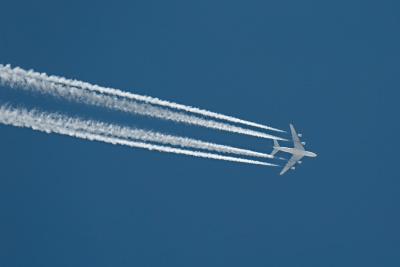
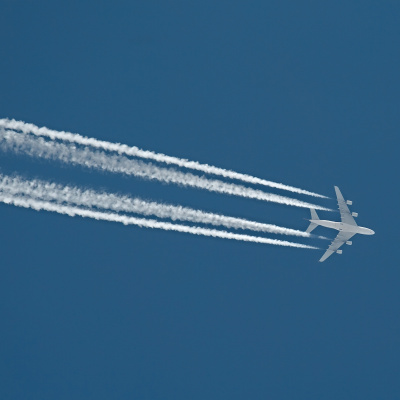
- Contrails and cirrus clouds: Contrails form when water vapor from aircraft engines encounters cold ambient air at high altitudes and forms ice crystals. Under certain atmospheric conditions, these form long-lived Contrail cirrus clouds, which trap heat radiation in the atmosphere and thus enhance the greenhouse effect.
- Water vapor: Water vapor is also released into the atmosphere as a by-product of kerosene combustion. It has a particularly strong impact on the climate at high altitudes, where it is less easily broken down. However, since water vapor only remains in the atmosphere for a short time, its warming effect is limited.
- Aerosols: These include, for example, soot particles and aerosol precursors such as sulfur compounds. Soot particles have a warming effect on the climate, while sulfate particles have a cooling effect. Indirectly, aerosols act as condensation nuclei for clouds, promoting cloud formation, which leads to warming.
How can aviation become more climate-friendly?
In order to reduce aviation's contribution to climate change, not only CO₂ emissions but also Non-CO₂ effects must be reduced. The Decarbonization of aviation requires a combination of technological innovations, alternative propulsion systems and fuels, Flight route optimization, and economic measures to reduce emissions.
Sustainable aviation fuels (SAF)
Sustainable aviation fuels (SAF) are considered one of the most promising solutions for reducing CO2 emissions and non-CO2 emissions in aviation. Over their entire life cycle, they can reduce CO₂ emissions by up to 95% compared to conventional Kerosene. In addition, SAF burn cleaner than fossil kerosene, thereby reducing Non-CO₂ effects.
Electrification and hydrogen technology
In addition to SAF, electric drives and hydrogen are also being tested as alternative technologies. However, electric aircraft are currently only suitable for ultra-short and short distances. Hydrogen can be burned directly, similar to Kerosene, without producing any CO₂ emissions. However, due to technical limitations, its use is likely to be limited to short to medium distances.
Regulatory and market-based instruments
A key instrument for reducing CO₂ emissions is the European Emissions Trading System (EU ETS). It is based on the cap-and-trade approach: airlines must surrender one certificate for every tonne of CO₂ emitted, with the total number of certificates decreasing annually. From 2025, Non-CO₂ effects will also be subject to reporting in the EU ETS.
Operational measures: Optimizing flight routes
Optimizing flight routes can also help to avoid climate-impacting Non-CO₂ effects. If ice-saturated regions are avoided, e.g., by changing altitude or flying around contrail hotspots, these non-CO₂ effects can be mitigated.
How aviation is becoming more sustainable
Strategies for reducing CO2 and non-CO2 emissions in aviation
What national and international strategies exist to reduce aviation emissions?
Aviation is set to become climate neutral by 2050. To achieve this goal, international, European, and national strategies, known as roadmaps, have been developed that include specific measures to reduce CO₂ and non-CO₂ emissions. The strategies encompass technological innovations as well as political frameworks and market-based approaches.
International strategies
Waypoint 2050 is an industry-wide international climate protection strategy for aviation. Developed by the Air Transport Action Group (ATAG), the strategy examines several scenarios for achieving carbon neutrality. These scenarios focus on four key levers: technological progress, more efficient operations, the use of SAF, and offsetting emissions through market-based instruments.
The International Civil Aviation Organization (ICAO) has adopted a global framework with comprehensive climate protection measures. At its core is the long-term aspirational goal (LTAG), with which member states have agreed on a common goal of net zero in aviation by 2050.
A central element of the ICAO strategy is the market-based system CORSIA (Carbon Offsetting and Reduction Scheme for International Aviation). The system is based on an “offsetting” principle: airlines compensate for their CO₂ emissions by investing in climate protection projects outside the aviation sector through the purchase of CO₂ certificates.
The aviation industry association, the International Air Transport Association (IATA), is pursuing its own roadmap to achieve Climate neutrality by 2050. Its strategy is based on four pillars, which include a combination of technological innovations, sustainable aviation fuels, and Compensation measures.
European strategies
Destination 2050 is a European industry alliance committed to promoting sustainable European aviation. The roadmap for decarbonizing European aviation combines several measures: improving aircraft and engine technologies, expanding sustainable aviation fuels (SAF), implementing economic measures, and improving air traffic management.
National strategies
Germany has also developed its national aviation strategy in line with EU objectives. In addition to technological innovations, the German aviation strategy focuses on the Market ramp-up of sustainable aviation fuels, a climate-neutral airport, and international cooperation. With the PtL roadmap, the German government is pursuing the promotion of synthetic fuels based on Renewable energies.

On the path to climate protection in aviation
International and national roadmaps for climate-neutral aviation by 2050
More information