
Mandates for sustainable aviation fuels (SAF) have been in effect in the EU since 2025. The “CENA SAF Outlook 2026: Volumes, Feedstocks, and Resilience” finds that the SAF mandates are likely to be met by European production through 2030. However, the announced production volumes fall significantly short of the mandated targets for the years beyond 2030 — particularly for synthetic electricity-based aviation fuels (E-SAF). Sustainable aviation fuels are the cornerstone of decarbonizing the aviation sector in the long term — especially for medium- and long-haul flights. A reliable regulatory framework at the EU level and improved investment conditions are crucial to accelerating the ramp-up of the SAF market.

CENA SAF-Outlook
Production Volumes, Feedstocks and Resilience in Sustainable Aviation Fuel Production
Key findings:
- Globally, production capacity of up to 33.7 million tonnes of SAF has been announced for 2030; a realistic projection is around 22 million tonnes
- The European SAF mandate can likely be met by 2030 through bio-SAF produced in Europe
- The e-SAF sub-mandate starting in 2030 is currently not secured
- Despite the increasing number of SAF projects, announced global production volumes are declining
- High production costs, high risks, and a lack of long-term off-take agreements are slowing market development
- Without supporting mechanisms, most SAF projects remain structurally uncompetitive
- E-SAF is increasingly being produced by new, specialized market actors rather than major oil companies
- Biogenic production pathways remain dominant worldwide, particularly HEFA
- Germany focuses technologically on e-SAF and the Fischer-Tropsch pathway
Stay up to date on developments in the SAF market.
Sign up here for updates on the CENA SAF Outlook.

CENA SAF-Outlook 2026 (EN)
The market analysis examines the development of the global, European, and German SAF market in terms of production volumes, feedstock used, technologies, and policy framework
09.06.2026 download (PDF 2,46 MIB )
The global production of SAF will remain significantly below the mandated demand after 2030
million tonnes of SAF
in 2026
million tonnes of SAF
in 2030
million tonnes of SAF
in 2035
The CENA SAF-Outlook 2026, commissioned by the Hessian Ministry of Economics, Energy, Transport, Housing and Rural Areas (HMWVW), indicates an increase in globally announced production capacity for SAF in the coming years. As of the data closure date of December 31, 2025 production announcements for 2026 already total nearly 10 million tonnes. By 2030, a maximum of 33.7 million tonnes of SAF is projected globally. This would correspond to 10–12 % of global Kerosene demand in 2030, which—depending on the source and scenario—is estimated at 300 to 350 million tonnes.
Of the 33.7 million tonnes of SAF announced globally for 2030, around 57 % are attributable to projects that are still in the planning phase. Numerous projects have not yet reached a final investment decision or began construction. Therefore, only about 22 million tonnes of SAF appear to be realistically achievable. Of this amount, 12 million tonnes come from facilities that are already in operation or are in the process of commissioning.
At the same time, this year’s Outlook shows declining production forecasts for 2030 for the first time. Despite an increase in the number of projects, the maximum volume forecast for 2030 has fallen from an initial 35.3 million tonnes of SAF to the current 33.7 million tonnes. In Europe in particular, announced capacities are about 15 % below last year’s forecast.
EU SAF mandate expected to be met by 2030 through European production – E-SAF sub-target not yet secured
With ReFuelEU Aviation, the EU requires fuel suppliers to provide an increasing share of sustainable aviation fuels starting in 2025. The mandate starts at 2 % and will gradually increase to 70 % by 2050. In addition, a sub-mandate for e-SAF will take effect in 2030, rising to 35 % by 2050.
The European SAF mandate is expected to be met by bio-SAF produced in Europe by 2030 — provided that most facilities currently being commissioned begin production as scheduled. However, the 1.2 % e-SAF sub-mandate starting in 2030 is still uncertain: most e-SAF projects are currently still in the early planning stages. To date, no European e-SAF project on an industrial scale has reached a final investment decision.
Based on current projections, neither the overall SAF mandate nor the e-SAF sub-mandate can be fully met by European production after 2035.
A lack of investment security is slowing market growth
Sustainable aviation fuels, particularly e-SAF, have significantly higher production costs than fossil Kerosene. Depending on the process and location, prices are roughly three to ten times the fossil fuel price (in non-crisis periods). In addition to the high production costs of first-of-a-kind plants, key market barriers include a lack of long-term off-take agreements, regulatory uncertainties, and high investment risks.
E-SAF production involves significantly greater financial risks for market entry compared to bio-SAF. The economic viability of many projects depends heavily on the availability of electricity, hydrogen, and CO₂ infrastructure. At the same time, there is currently a lack of robust market mechanisms that provide long-term planning certainty for producers and investors.
This reveals a key issue in the SAF market: producers will only invest once there is guaranteed demand, while airlines typically only purchase larger volumes once costs have fallen. Without additional hedging mechanisms, Market ramp-up is significantly more difficult.
Industrial policy safeguard measures are crucial for the SAF market ramp-up
The CENA SAF-Outlook 2026 shows that, under current market conditions, the necessary ramp-up of sustainable aviation fuels is unlikely to succeed on its own. Long-term reliable political and economic conditions that reduce investment risks and provide planning certainty are crucial. This way private investment and technological development can be secured.
Key measures include:
- Tax incentives through the aviation tax for the use of SAF
- Structural safeguards for SAF projects, particularly for long-term purchase agreements via intermediary models
- Use of the aviation tax as initial funding for first e-SAF plants
- Government guarantees and grandfathering provisions for early plants
- Expansion of renewable energy as well as hydrogen and CO₂ infrastructure
Resilient supply chains and intra-European production capacities are becoming increasingly important
In addition to the necessary ramp-up of the SAF market, supply security is also becoming an increasingly focal point. Although Europe is relatively diversified in its use of biogenic feedstocks, it remains heavily dependent on imports — particularly from countries such as China and Malaysia — for used cooking oils and animal fats used in SAF production via the HEFA-pathway. In 2024, approximately 70% of the SAF feedstocks used in Europe were imported from non-EU countries (EASA 2025).
The issue of resilient production structures and supply chains is also becoming increasingly important for e-SAF. In addition to renewable electricity and hydrogen, the long-term availability of suitable CO₂ sources is becoming a key factor for the further ramp-up of synthetic aviation fuels.
Germany is focusing on e-SAF and the Fischer-Tropsch pathway
tonnes of announced SAF production
in Germany for 2030
share of e-SAF
in the announced German SAF production for 2030
Compared internationally and within Europe, Germany is placing a clear technological emphasis on e-SAF. While HEFA continues to dominate worldwide, e-SAF accounts for more than half of the announced production capacity in Germany. Within this segment, the Fischer-Tropsch pathway is particularly prominent.
At the same time, the analysis shows that announced production capacity in Germany has been declining for the second year in a row. While the CENA SAF Outlook 2024 projected more than 1 million tonnes of SAF by 2030, current announcements amount to only around 370,000 tonnes per year. Reasons for this include reduced project sizes, postponed investment decisions, and canceled projects.
The first industrial e-SAF plants in Hessen are providing a significant boost to the scaling up of technology
Despite declining production forecasts, Germany remains a major hub for the development of e-SAF technologies in Europe. By promoting innovative technologies, Hessen is making a significant contribution to the transformation of the aviation industry. The state is providing targeted support for the first pilot and demonstration facilities in e-SAF production - so-called “first movers.”
Key funded projects include INERATEC’s “ERA ONE” demonstration plant and CAPHENIA’s “GERMANY I” pilot plant in the Frankfurt-Höchst Industrial Park. The state of Hessen is supporting both projects with grants of over 1 million euros each. While INERATEC is developing the ERA ONE plant—one of Europe’s largest power-to-liquid facilities in operation for the production of Synthetic fuels—CAPHENIA is working on power-and-biogas-to-liquid processes for the production of synthesis gas for synthetic jet fuels. With their innovative processes for producing synthetic jet fuels, both projects are making an important contribution to the technological ramp-up in Germany.
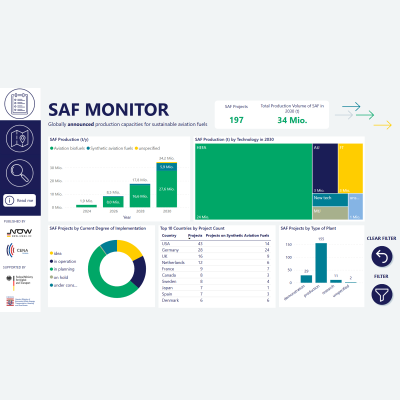
SAF-Monitor
The interactive data visualization shows the SAF projects announced worldwide based on the CENA SAF Outlook.