
Aviation is one of the fastest growing forms of transport worldwide and a significant source of greenhouse gases. In addition to carbon dioxide (CO₂) emissions, aviation also produces a range of so-called non-CO₂ effects, such as water vapor, nitrogen oxides, and contrails, which can have a significant impact on the climate. This article analyzes the various climatic effects of aviation, how they arise, and their role in the context of climate change.
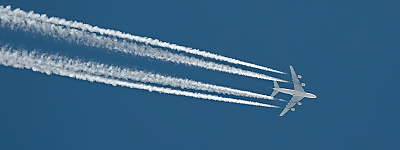
Climate impact of aviation
Formation and impact of CO₂ and non-CO₂ emissions from aviation
Impact of aviation on the Earth’s radiative balance
The Earth is in radiative equilibrium when the energy it receives from solar radiation equals the energy it radiates into space. This equilibrium is disrupted when anthropogenic greenhouse gas emissions retain long-wave radiation in the atmosphere. Consequently, less energy leaves the atmosphere, resulting in an imbalance in the radiation balance. This manifests as an increase in ground-level temperatures, known as the greenhouse effect.
Aviation contributes to changes in atmospheric composition and disturbances in the radiation balance through its emissions. The combustion of Kerosene in aircraft engines produces CO₂. This combustion process not only releases carbon dioxide, but also generates water vapor (H₂O), which has an additional impact on climate. For every kilogram of kerosene burned, approximately 3.15 kilograms of CO₂ are produced. Carbon dioxide is a particularly effective greenhouse gas because it absorbs radiation emitted from the Earth's surface, causing it to remain in the atmosphere rather than being radiated back into space. This warms up the lower atmosphere.
A key characteristic of CO2 is its long residence time in the atmosphere. Once emitted, it remains in the atmosphere for more than 1,000 years
before being absorbed by natural processes. This means that all CO2
emissions since well before industrialization have accumulated in the atmosphere and will remain there for a very long time. Air transport contributes around 3 percent to global CO2 emissions through the combustion of fossil fuels.
1/3
of aviation emissions are CO2 emissions
2/3
of aviation emissions are non-CO2 emissions
In addition to CO2 and water vapor, the combustion of Kerosene also produces indirect Greenhouse gases that influence the concentrations of other greenhouse gases, such as ozone and methane. When these non-CO₂ effects are considered, their impact on the climate is relatively large. Only around a third of the Climate impact of aviation is due to CO₂ emissions; the rest is due to non-CO₂ effects. The radiative forcing of aviation thus accounts for about 5% of total historical anthropogenic global warming.
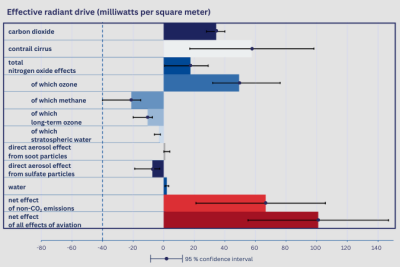
Contribution of Aviation emissions to effective radiative forcing; Source Lee et al. (2021)
Climate-relevant non-CO2 effects of aviation
In addition to the direct greenhouse gas CO₂, the combustion of Kerosene in aviation releases other climate-relevant substances. These so-called non-CO₂ emissions include particulate emissions, water vapor, and nitrogen oxides (NOX), which have a particularly high Climate impact at typical aviation altitudes. At these altitudes, they influence the formation of aerosols and clouds and alter the concentration of atmospheric gases such as ozone and methane. Non-CO₂ emissions have a direct impact on the Earth's radiation balance, as they alter the reflection and absorption of radiation and thus contribute to global warming.
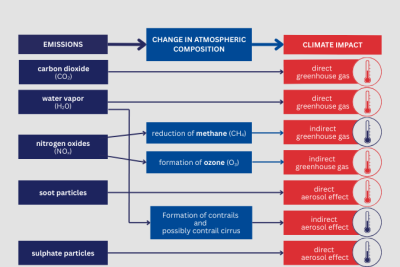
Atmospheric effects of Aviation emissions, Source Sausen et al. 2017
Contrails and cirrus clouds
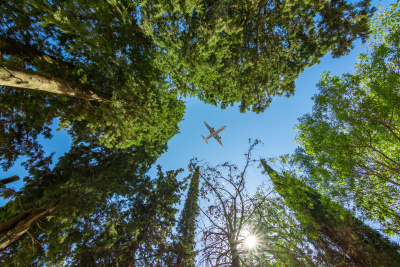
Contrails are one of the most visible effects of air traffic. They form when water vapor released during the combustion of kerosene encounters cold ambient air and forms ice crystals. These white contrails typically form at altitudes between 8 and 12 kilometers. Under certain atmospheric conditions, especially in humid and cold air layers (ice-saturated regions), contrails can develop into long-lived Contrail cirrus clouds, which can last from a few minutes to several hours. These regions are primarily located over the North Atlantic.
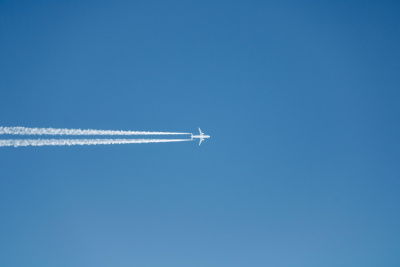
Contrails in the sky
The climatic effects of these cirrus clouds can have a warming or cooling effect
depending on the time of day and the ground surface. On the one hand, Contrails reflect sunlight back into space, which can have a slight cooling effect. If they occur in the morning hours, they shield part of the solar radiation, causing the atmosphere to warm up less. On the other hand, they trap the infrared heat radiated from the Earth's surface and prevent it from escaping into space. This effect occurs when cirrus clouds form in the evening hours, preventing cooling at night. Overall, they have a warming effect: Studies show that the radiative forcing of Contrail cirrus clouds is about twice as large as that of CO2 emissions, making them a significant factor in aviation´s Climate impact.
Water vapor (H2O)
When Kerosene is burned in aircraft engines, water vapor (H₂O) is produced as a major reaction product in addition to carbon dioxide. The release of water vapor at altitudes between 8 and 12 kilometers is particularly significant for the climate, as the natural concentration of water vapor is considerably lower than at ground level and the decomposition process is slower.
While water vapor remains at ground level for only a very short time, as it quickly condenses into clouds and rains out, it remains at high altitudes for several days to weeks. There, it acts as an effective greenhouse gas that contributes to the warming of the atmosphere. This effect increases with altitude.
Despite its impact on the climate, the effect of water vapor in aviation remains limited compared to other Greenhouse gases. Due to its short residence time, it cannot spread evenly throughout the atmosphere and only has a local effect. This leads to a comparatively low warming effect of only about 2% of the Climate impact of aviation.
Nitrogen oxides (NOX)
Nitrogen oxides (NOx) are formed as a by-product of Kerosene combustion through the oxidation of nitrogen contained in the air. Nitrogen oxides have a very short residence time in the atmosphere and do not directly affect the atmospheric radiation balance. However, when interacting with other gases, they trigger a series of chemical processes that have various effects on the climate. Two of the most important reactions involve the formation of ozone (O₃) and the reduction of methane (CH₄).
Formation of ozone
One of the main consequences of NOX emissions is the catalytic formation of ozone (O₃). This reaction occurs primarily at high altitudes under the influence of sunlight and intensifies with increasing solar radiation and altitude. The effect is particularly pronounced in heavily trafficked flight paths in the mid-latitudes of the northern hemisphere. Although ozone acts as a protective layer in the stratosphere, increased ozone concentrations at ground level deteriorate air quality and contribute to the formation of smog. At typical flight altitudes, however, ozone acts as a short-lived greenhouse gas with a residence time of two to eight weeks, which limits its effect on the atmosphere to a regional level.
Reduction of methane
Another effect of NOX emissions is the reduction of methane (CH₄) concentrations in the atmosphere. This occurs through the formation of hydroxyl radicals (OH) as a by-product of ozone production. These radicals lead to the degradation of methane. While ozone is a relatively short-lived gas, methane has a much longer residence time of about 10 to 12 years and contributes to warming in the atmosphere.
The degradation of methane therefore leads to a cooling effect in the atmosphere in the long term. In addition, the reduced methane concentration reduces the formation of hydrogen in the stratosphere, which also has a cooling effect.
Despite this cooling effect, the overall impact of NOₓ emissions remains net warming, as the ozone produced by NOX has a significantly stronger warming effect on the atmosphere than the cooling effects of methane degradation.
Aerosols
Air traffic emits both aerosols (e.g., soot particles) and aerosol precursors (e.g., nitrogen and sulfur compounds), which can form aerosols containing sulfate or nitrate in the atmosphere. These aerosols have different climate impacts, which can have both cooling and warming effects. The exact effect depends on the physical and chemical properties of the particles and the atmospheric conditions.
Direct aerosol effects
The direct climatic effect of aerosols depends on their ability to reflect or absorb solar radiation. Aerosols such as sulfate particles reflect a large proportion of short-wave solar radiation back into space, which leads to a cooling of the atmosphere as fewer sun rays REACH the Earth's surface. In contrast, aerosols such as soot particles absorb a large proportion of solar radiation. This absorbed energy is released as heat into the atmosphere, which has a climate-warming effect. Since aerosols have a relatively short lifespan of days to weeks, their overall Climate impact is limited and usually only leads to a small change in the climate.
Indirect aerosol effects
Aerosols, such as sulfate and soot particles, act as cloud condensation nuclei, which means they can significantly influence the formation and properties of clouds. A higher concentration of such condensation nuclei leads to the increased formation of cloud droplets and crystals. This causes clouds to reflect more sunlight, thereby reflecting more radiation back into space. In addition, the lifespan of clouds is extended because smaller droplets rain out more slowly. These clouds can therefore also lead to cooling. However, due to their comparatively minor impact on the climate, indirect aerosol effects are not usually taken into account when assessing the overall Climate impact of aviation.
More information

Federal Environment Agency (2019): https://www.umweltbundesamt.de/sites/default/files/medien/1410/publikationen/2019-11-06_texte-130-2019_umweltschonender_luftverkehr_0.pdf
Federal Environment Agency (2023): https://www.umweltbundesamt.de/sites/default/files/medien/479/publikationen/fb_klimawirkung_des_luftverkehrs_0.pdf
IPCC (2021): https://www.ipcc.ch/report/ar6/wg1/downloads/report/IPCC_AR6_WGI_FullReport.pdf
Lee et al. (2021): https://www.sciencedirect.com/science/article/pii/S1352231020305689?via%3Dihub