
Aviation accounts for around 3% of global CO2 emissions, but its impact on the climate goes far beyond this share. In addition to direct CO2 emissions, aviation causes a variety of so-called non-CO₂ effects. These effects include water vapor, nitrogen oxides (NOx), contrails, and aerosols, which have a significant impact on the climate. Decarbonising aviation is therefore a complex challenge that requires holistic solutions. This article presents various approaches to reducing the climate impact of aviation—from alternative propulsion systems and fuels to flight route optimization and economic measures.

How aviation is becoming more sustainable
Strategies for reducing CO2 and non-CO2 emissions in aviation
Reduction of CO2 emissions through alternative drive systems and fuels
One of the key strategies for reducing CO2 emissions is the development and use of alternative propulsion systems and fuels. The focus here is primarily on sustainable aviation fuels (SAF), hydrogen, and electric propulsion systems. These approaches aim to replace fossil Kerosene with more climate-friendly fuels with a lower carbon content. Fuels are considered CO2-neutral if they are produced using renewable energy from sustainable sources and thus release only as much CO2 during combustion as was bound during production.
The requirements for aircraft and infrastructure vary depending on the propulsion system or fuel. Sustainable aviation fuels are classified as drop-in fuels because they can be used in existing aircraft in the same way as conventional kerosene. In contrast, non-drop-in fuels, such as hydrogen or electric propulsion systems, require modifications to existing aircraft and/or engine types.
Sustainable Aviation Fuels (SAF)
Sustainable aviation fuels are currently considered the most promising option for reducing CO2 and non-CO2 emissions in aviation. They can be used in much the same way as conventional kerosene and are therefore already suitable for use on medium- and long-haul flights.
Unlike fossil fuels, the combustion of SAF does not produce any additional CO₂ emissions, as the carbon used has previously been bound from sustainable sources. This closes the CO₂ cycle almost completely and reduces net emissions. Over the entire life cycle, CO₂ emissions can be reduced by up to 95 % compared to conventional kerosene.
Depending on the SAF production process, up to 50 % can be blended with fossil kerosene. The end product must meet the international standards and certifications of the ASTM that apply to conventional JetA1 kerosene. Sustainable aviation fuels can be produced in two ways: biomass-based SAF is produced from renewable raw materials such as waste materials, oil plants, and used cooking oils, while synthetic SAF, known as E-kerosene, is produced using power-to-liquid processes. There are currently nine approved SAF production processes, including technologies such as Hydroprocessed Esters and Fatty Acids (HEFA), Alcohol-to-Jet (AtJ), and Fischer Tropsch (FT).
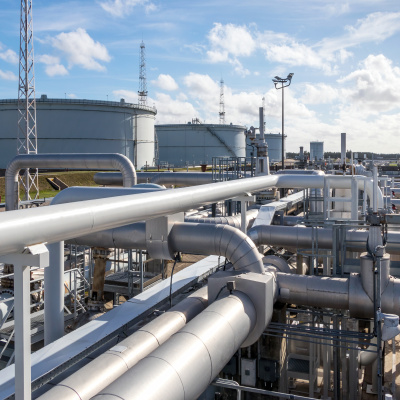
What types of SAF are there and how are they produced?
Electric drive systems
Electric aircraft are considered a possible solution for decarbonizing short-haul aviation. These aircraft use electric motors powered either by batteries or fuel cells. A key advantage of this technology is that it does not cause any direct CO₂ emissions. If the electricity used comes from renewable sources, the entire flight can be made almost climate-neutral
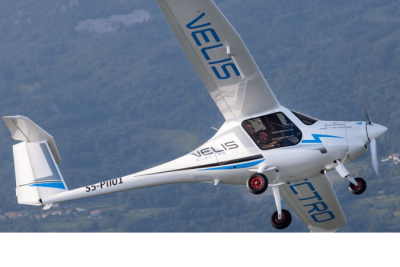
The Pipistrel Velis Electro is the first fully electric aircraft to receive type certification from the European Union Aviation Safety Agency (EASA).
There are various approaches to developing electric aircraft, including fully electric aircraft and hybrid aircraft. Fully electric aircraft are equipped exclusively with electric engines and are powered directly by them. In contrast, hybrid aircraft combine electric drive systems with conventional engines, thereby enabling longer ranges.
The biggest challenge for the development of electric aircraft currently lies in the limited energy density of batteries and their weight. The energy density of today's batteries is only a fraction of that of Kerosene, meaning they store significantly less energy per unit of weight than kerosene. These limitations have a direct impact on the range and payload of electric aircraft. The only purely electric aircraft approved to date are single- or two-seater sports aircraft.
Hydrogen as aviation fuel
Hydrogen can be used as an alternative fuel to fossil Kerosene, provided that it is produced as so-called green hydrogen, i.e., by means of Electrolysis using renewable electricity. Hydrogen can be used in aviation in two ways:
- Hydrogen in fuel cells: Hydrogen is converted into electricity in a fuel cell, which then powers an electric motor. No CO₂ emissions are produced during operation. Various hydrogen fuel cell aircraft are currently undergoing certification and could carry up to 20 passengers.
- Direct combustion of hydrogen in turbines: Similar to kerosene, hydrogen can be burned directly in modified gas turbines. This produces water and nitrogen oxides, but no CO₂ emissions. However, there are currently no aircraft types that use hydrogen in turbines.
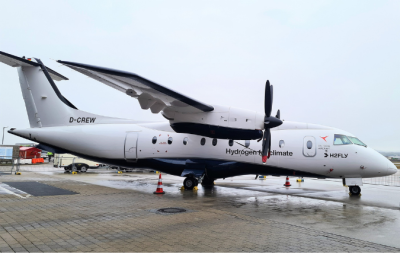
The Stuttgart-based start-up H2Fly has developed a hydrogen-powered electric aircraft.
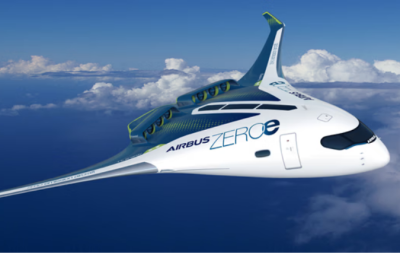
Airbus' blended wing body concept for a hydrogen combustion engine.
A key advantage of hydrogen is that it produces almost exclusively water when it burns, meaning CO₂ emissions can be avoided entirely. At the same time, hydrogen has a high energy density, which means that this chemical Energy carrier can store a lot of energy in a relatively small amount of weight.
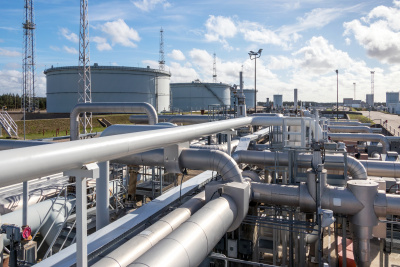
However, hydrogen has a significantly lower energy density per volume than Kerosene. This poses technological challenges for the safe transport and storage of hydrogen. Since cryogenic and pressure tanks are very heavy and large, only a relatively small amount of hydrogen can be transported on board, which severely limits the range of hydrogen aircraft. To address this, a new aircraft design would be needed for longer distances, such as the one currently being considered by Airbus (e.g., “blended wing body”). Another challenge is the lack of infrastructure: all airports that would be served by hydrogen would need to have the appropriate pipeline, tank, and liquefaction infrastructure in place.
Economic measures: The EU Emissions Trading System (EU ETS)
A key element of EU climate policy to reduce greenhouse gas emissions in European aviation is the EU Emissions Trading System (EU ETS). Since its introduction in 2005, the EU ETS has followed the “cap and trade” system (Directive 2003/87/EC): An upper limit (cap) is set for the total amount of CO2 emissions that all participating companies are allowed to emit. Companies receive corresponding emission allowances for their CO2 emissions, which can either be allocated free of charge or purchased through auctions. Each of these allowances permits the emission of one ton of CO₂. These emission allowances can be freely traded on the market. If a company emits less than it is allowed to, it can sell surplus allowances. Conversely, companies that emit more CO₂ must purchase additional allowances on the market.
Aviation has also been integrated into the system since 2010. All flights taking off and landing within the European Economic Area (EEA) are subject to the obligation to surrender emission allowances (Directive 2008/101/EC).
As part of the Fit for 55 package, the EU ETS for aviation has been strengthened. The reduction target has been raised from the original 43% to 62% compared to 2005. The linear reduction factor (LRF), the measure by which emission allowances are reduced annually, will also be increased from 2.2% to 4.3% (from 2024) and further to 4.4% (from 2028). In addition, the cap on allowances will be gradually reduced: initially by 90 million allowances in 2024 and by 27 million allowances in 2026.
From 2026, the previous free allocation of emission allowances will end and be supplemented by the introduction of a new regulation. This stipulates that airlines will receive up to 20 million so-called “SAF allowances” for the use of SAF. These “SAF allowances” are certificates allocated free of charge to help offset the additional costs incurred by the mandatory Blending quota for sustainable aviation fuels.
Mitigation of non-CO2 effects through sustainable aviation fuels and optimized flight routes
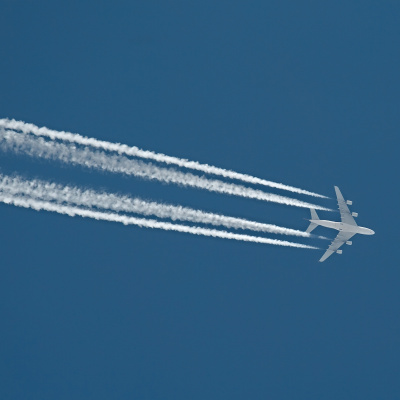
Non-CO2 effects are caused by emissions of particles, water vapor, sulfur oxides, and nitrogen oxides. While some of these have a direct impact, most affect the climate indirectly through physical processes and chemical transformations in the atmosphere. Where and when the emissions are released is particularly relevant - for example, at altitude or under certain weather conditions. Non-CO₂ effects are considered a significant factor in aviation's Climate impact, accounting for around two-thirds of its total impact.
What are non-CO2 effects?
Various strategies are available to reduce non-CO2 effects:
- Use of sustainable aviation fuels (SAF):
Synthetic alternatives such as E-kerosene in particular release significantly fewer soot particles during combustion than fossil kerosene. This reduces the formation of Contrails and the resulting cirrus clouds, which have a warming effect on the climate. SAF therefore not only contributes to CO₂ reduction, but also to the mitigation of climate-impacting non-CO₂ effects.
- Optimization of flight routes to avoid climate-sensitive areas and times: Flight route optimization offers great potential for reducing the Climate impact of aviation. The specific aim is to reduce the impact of emissions in the atmosphere. This is because the location and timing of emissions have a major influence on their climate impact.
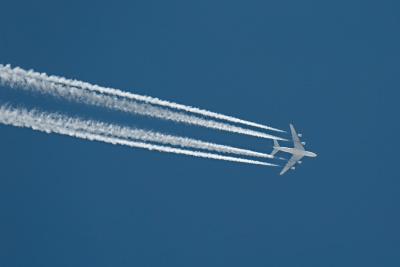
Commercial aircraft typically fly at altitudes between 10 and 15 kilometers, where a particularly large number of chemical and microphysical processes take place. These processes are highly dependent on atmospheric conditions such as temperature, humidity, and pressure. A key objective of optimized flight route planning is to avoid the formation of contrails and the resulting cirrus clouds. Contrails form when water vapor emitted by aircraft engines encounters cold, moist air and ice crystals form, which become visible as long streaks. Under certain atmospheric conditions, these contrails can develop into long-lived contrail cirrus clouds, which contribute to the warming of the atmosphere. By temporarily changing the altitude or flying around ice-saturated contrail hotspots, the formation of contrails can be reduced and the residence time of ozone in the atmosphere can also be decreased.
While conventional flight planning aims to find the most economical route, taking climate-related factors into account could enable more climate-friendly flight paths. These are based on current weather and traffic forecasts, measurements taken on the aircraft, and calculation models for the local and temporal formation of ice-saturated regions.
From 2025, reporting requirements for non-CO2 effects will also be introduced under the EU ETS. This obligation will initially be implemented through a system for monitoring, reporting, and verifying (MRV) non-CO2 effects in aviation. By the end of 2027, the European Commission must submit a report on how non-CO2 effects can be reduced, e.g., by integrating non-CO2 effects into the tax liability. In addition, CORISA will be implemented in the EU ETS in the European Economic Area for flights to and from third countries and between third countries.
More information

Abel (2022): https://publikationen.bibliothek.kit.edu/1000143463
EASA (n.D.): https://www.easa.europa.eu/de/light/topics/hydrogen-and-its-potential-aviation
Federal Environment Agency (2019): https://www.umweltbundesamt.de/sites/default/files/medien/1410/publikationen/2019-11-06_texte-130-2019_umweltschonender_luftverkehr_0.pdf
Federal Environment Agency (2023): https://www.umweltbundesamt.de/sites/default/files/medien/479/publikationen/fb_klimawirkung_des_luftverkehrs_0.pdf
InnoFuels (2024): https://redaktion.hessen-agentur.de/publication/2024/4311_InnoFuels_AnwendungsfeldLuftfahrt_BestandaufnahmeGesetzeundIndustriestandardszumSAF-Markthochlauf.pdf
Lee et al. (2010): https://www.sciencedirect.com/science/article/pii/S1352231009004956