
To achieve the goal of climate neutrality in aviation by 2050, numerous strategies have been developed at the international, European, and national levels that provide for concrete measures to reduce CO₂ and non-CO₂ emissions. This article provides an overview of the most important initiatives and strategies in the aviation industry and highlights technological innovations, political frameworks, and market-based approaches.

On the path to climate protection in aviation
International and national roadmaps for climate-neutral aviation by 2050
Waypoint 2050: An industry-wide climate protection strategy for international aviation
“Waypoint 2050” is the key international climate protection strategy for global aviation. Developed by the global aviation industry network ATAG (Air Transport Action Group), it brings together the most important players in the industry – airlines, airports, air traffic control and aircraft manufacturers – with the common goal of making aviation carbon neutral by 2050. The “Waypoint 2050” report examines several possible scenarios for how the aviation sector could achieve net-zero emissions:
- Scenario 1: By pushing technology and operations
- Scenario 2: By aggressively deploying sustainable fuels
- Scenario 3: By adopting an aspirational and aggressive technology perspective
The three scenarios pursue four key levers for decarbonizing aviation:
- Technological progress: Further development of drive systems (electric, hydrogen, and hybrid electric aircraft), more efficient engines, and lighter materials contribute to reducing emissions. Depending on the scenario, CO2 savings could range between 12% and 34% by 2050.
- Efficient operation: Improvements in infrastructure, structural changes in air traffic management, and energy savings at airports can save an additional 7-10% of CO2.
- Sustainable aviation fuels (SAF): The greatest contribution to CO2 neutrality is to be made through the use of sustainable aviation fuels. Depending on the scenario, between 53% and 71% of CO2 reductions can be achieved through sustainable fuels.
- Compensation through market-based instruments: To offset remaining emissions, “Waypoint 2050” relies on compensation systems in all three scenarios. These are expected to cover 6-8% of CO2 savings.
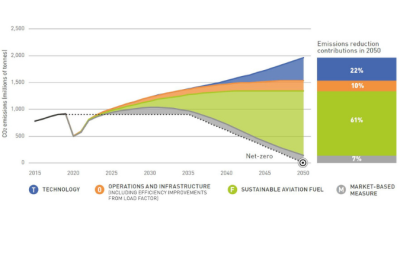
Contribution of individual measures to achieving net zero emissions in aviation according to Waypoint 2050
ICAO – Global guidelines for net zero by 2050 in aviation
In November 2023, the International Civil Aviation Organization (ICAO) adopted a global framework of measures to reduce the environmental impact of the international aviation industry. The goal is to reduce CO₂ emissions from international aviation to net zero by 2050. Key elements include the development and refinement of harmonized regulations and supporting implementation initiatives, such as the ACT-SAF program, which aims to help member states build capacity and improve access to financing. ICAO is a specialized agency of the United Nations (UN). It was founded in 1994 to create uniform global standards and regulations for international aviation.
In line with the Paris Agreement, the member states of the ICAO have agreed on a global long-term climate goal: the long-term aspirational goal (LTAG). The LTAG does not set binding reduction targets for countries, but takes into account their national circumstances, such as the level of development of their aviation markets and technical capacities, in order to allow each country to make a flexible contribution.
To achieve the LTAG, ICAO is focusing on four sub-strategies:
- Integration of innovative aircraft technologies, such as hydrogen and electric drives, as well as improvements in aerodynamics, engine efficiency, and lightweight aircraft construction.
- Increased efficiency in flight operations through expansion of airport and airspace infrastructure, more efficient flight procedures, and optimization of air traffic management.
- Increased use of sustainable aviation fuels and energy sources through the use of biogenic and Synthetic fuels, as well as novel drive energies such as battery storage and hydrogen for fuel cells and gas turbines.
- Improved financing options for the implementation of the necessary measures.
A central element of the ICAO strategy to limit CO₂ emissions in international aviation is the market-based CORSIA (Carbon Offsetting and Reduction Scheme for International Aviation) system. It aims to offset the growth in CO₂ emissions from international aviation from 2021 onwards. Airlines will have to offset emissions above the baseline level by purchasing emission credits from recognized climate protection projects.

What is CORSIA and how does the system work?
IATA Roadmap for the aviation industry – Four pillars for climate-neutral growth in aviation
The International Air Transport Association (IATA) represents around 290 airlines worldwide and around 82% of global aviation. In October 2021, the association presented its own roadmap for achieving Climate neutrality by 2050 and, one year later, agreed to the ICAO's ambitious long-term goal “LTAG.” This means that both institutions are pursuing the same Decarbonization goals at the global level. The “Net zero carbon 2050 resolution” climate protection strategy is based on a combination of technological innovations, sustainable aviation fuels, and Compensation measures.
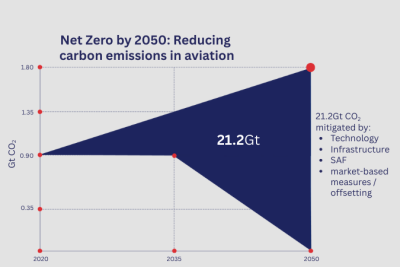
Reduction of CO₂ emissions in aviation by 2050, according to the IATA roadmap
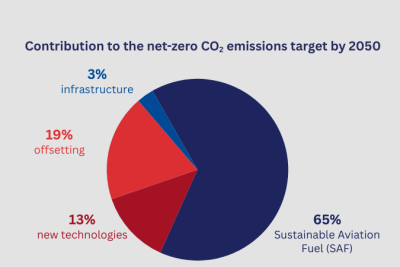
Contribution of individual measures to the net zero target for aviation by 2050, according to the IATA roadmap
The four pillars of IATA's climate protection strategy:
- Sustainable Aviation Fuels (SAF): For IATA, the use of SAFs plays a crucial role in reducing emissions. SAFs are expected to contribute 65% to emissions reduction and the achievement of Climate neutrality by 2050. Various types of SAFs are being used, including biofuels and Synthetic fuels.
- Investment in technology: IATA estimates that around 13% of emissions reductions can be achieved through technological advances in aircraft. These include improved engines, lighter materials, and improved aerodynamics.
- Increased efficiency: Further CO₂ reductions of 3% are to be achieved through improved use of airspace, more efficient flight routes, and optimized management of airports and flights.
- Market-based measures: IATA is pushing for a global system that requires airlines to invest in climate Compensation projects to offset their environmental impact. IATA rejects regional and local measures such as the European Emissions Trading System (EU ETS) because it distorts the market in a global industry such as aviation.
Destination 2050: The European industry's goal of climate-neutral aviation
Destination 2050 is a European industry alliance committed to promoting sustainable European aviation. The goal is to make aviation climate-neutral by 2050, in line with EU climate targets and the Paris Agreement. The roadmap to Destination 2050 is an ambitious path to decarbonize European aviation and comprises a combination of several key strategies aimed at reducing net CO2
emissions on flights:
- Improving aircraft and engine technologies
- Expanding sustainable aviation fuels (SAF)
- Implementing economic measures (such as the EU ETS)
- Improving air traffic management (ATM)
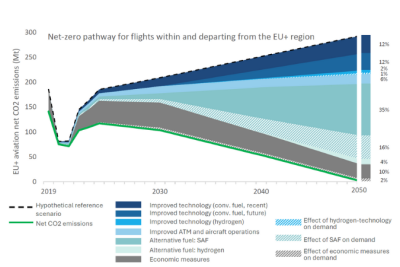
Pathway to net-zero emissions for flights within and from the EU+ region by 2050
For 2030, the industry target is to reduce CO2 emissions on intra-European flights by 55% compared to 1990 levels, as well as to reduce emissions on all flights within and from the EU compared to business-as-usual scenarios. By 2050, all flights within and from the EU should achieve net-zero CO2 emissions. This means that emissions from flights will be reduced as much as possible, with the remaining emissions in the atmosphere being removed by natural carbon sinks or special technologies (carbon capture and storage, CCS).
%
Reduction in CO2 emissions on intra-European flights compared to 1990
%
Reduction of CO2 emissions on all flights within and from the EU
%
Net zero emissions for all flights within and from the EU
Germany's aviation strategy – climate neutrality by 2050
Germany has developed its national aviation strategy in line with EU objectives. The focus is on climate protection, technological innovation, and international cooperation in order to reduce CO₂ emissions while strengthening aviation's role as an important economic sector. The key components of the aviation strategy include, in particular:
1. Improving aircraft efficiency and disruptive technologie
Germany supports the modernization of aircraft fleets and the development of lower-emission engines. In cooperation with the aviation industry and research institutes, Germany promotes aircraft that are manufactured, operated, and maintained in a climate-neutral manner.
2. Market ramp-up of sustainably produced aviation fuels
As aviation will remain dependent on liquid fuels for long-haul flights in the foreseeable future, Germany is promoting the production and use of SAF. In 2019, the federal government, the states, and industry published the PtL Roadmap, which is intended to drive the development and scaling of SAF in the coming years. A key element of this strategy was a quota for the Blending of PtL kerosene, which was abolished before it came into force with the coalition agreement presented on April 9, 2025, and is now to be brought into line with EU law. Another key point is the long-term goal that synthetic fuels based on renewable energy should cover the majority of fuel demand.
3. Climate-neutral airport
The federal government is promoting measures to expand electric mobility on the apron and the charging infrastructure, as well as the expansion of more climate-friendly ground power systems to reduce GHG emissions at airports.
4. Strengthening international cooperation
As aviation is a global industry, Germany is strongly committed to international cooperation. This includes regulatory and fiscal measures at national, European, and global level, such as EU ETS, CORSIA, and the Long-Term Global Aviation Goal (LTAG).
More information



ATAG (2021): https://aviationbenefits.org/media/167417/w2050_v2021_27sept_full.pdf
ATAG (2021): https://aviationbenefits.org/media/167418/w2050_v2021_27sept_summary.pdf
ATAG (n.D.): https://aviationbenefits.org/environmental-efficiency/climate-action/waypoint-2050/
BMV (n.D.): https://www.bmv.de/SharedDocs/DE/Anlage/K/presse/037-klimaneutrale-luftfahrt.pdf?__blob=publicationFile
Destination 2050 (n.D.): https://www.destination2050.eu/
Federal Government of Germany (2021): https://www.bmv.de/SharedDocs/DE/Anlage/LF/ptl-roadmap.pdf?__blob=publicationFile
IATA (2019): https://www.iata.org/contentassets/84c44b04754b42dd92d867dc8a8b4254/germany-competitiveness-index-report-german.pdf
IATA (2021): https://www.iata.org/contentassets/834c8a8813b843b6b5167b190269fbc3/german_pr_2009_12_08_01.pdf
IATA Fact sheet: https://www.iata.org/en/iata-repository/pressroom/fact-sheets/fact-sheet-iata-net-zero-resolution/
InnoFuels (2024): https://redaktion.hessen-agentur.de/publication/2024/4311_InnoFuels_AnwendungsfeldLuftfahrt_BestandaufnahmeGesetzeundIndustriestandardszumSAF-Markthochlauf.pdf