
The production costs for sustainable aviation fuels (SAF) are still significantly higher than those for fossil kerosene. Targeted incentives and promotional measures are therefore needed on both the supply and demand sides to reduce costs and accelerate the ramp-up of the SAF market. This article provides an overview of measures to promote SAF – from regulatory mandates and tax incentives to direct investment programs, which are already being implemented to varying degrees globally.
Accelerating the market ramp-up of sustainable aviation fuels
International and national incentive and promotion measures
SAF mandates and government purchase guarantees increase demand for SAF
In 2023, airlines worldwide covered only 0.01% of their kerosene requirements with sustainable aviation fuels. Since 2025, a mandatory Blending quota of 2% has been in force for aviation fuel suppliers in the European Union. Mandatory blending quotas and state-regulated purchasing systems are among the measures being used to specifically increase demand for SAF.
In the European Union, ReFuelEU Aviation has imposed a mandate of initially 2% since 2025. This is to be gradually increased to 70% by 2050. But it is not only in Europe that legal requirements are being used to oblige fuel suppliers to provide and fuel consumers to purchase SAF. Fuel supply obligations also apply in South Korea, the United Kingdom, Singapore and British Columbia in Canada. Asia, Taiwan and Indonesia are relying on mandates for SAF use by airlines. In Brazil, a quota for reducing CO2 emissions is being imposed.
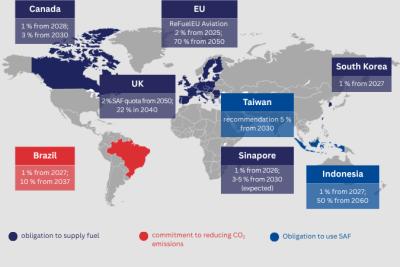
Overview of the provision and use of SAF
Such staggered quotas are a suitable means of enabling the gradual market introduction of SAF – especially given the still limited production capacities.
In addition, sustainable aviation fuels are also taken into account in reduction and trading systems such as the European Emissions Trading System (EU ETS) and the international climate protection instrument (CORSIA). The use of SAF can reduce the number of emission allowances that need to be purchased.
To support demand for SAF, Canada is providing USD 135 million in funding for low-carbon fuels for the federal government's aviation and shipping fleets. Further commitments to CO2-neutral business travel and the use of SAF by governments have not yet been implemented.
Financial support for the construction and operation of production facilities
In order for sustainable aviation fuels to be available on a larger scale in the future, supply must keep pace with expected demand. However, the construction and operation of production facilities, from the development stage to large-scale commercial operation, require high levels of investment. There is also a high need for investment in research and development in order to promote new technologies in their early stages and optimize existing technologies. Therefore, many countries are relying on financial incentives to promote both the construction of production facilities and their operation, thereby reducing the long-term costs of SAF.
Project funding via capital grants is provided in Europe through the EU Innovation Fund, in the US through the Inflation Reduction Act, and in Japan and the UK. In addition, both the European Union and the US use loans from the EU Investment Bank and the Inflation Reduction Act, respectively. Tax credits for manufacturers have only been used in isolated cases to date. Concrete measures to reduce the additional costs incurred by buyers through the use of SAF have so far only been implemented temporarily at individual airports – for example, at Düsseldorf Airport,in Brussels, and at Amsterdam/Schiphol airport for a limited period until the end of 2024.
Since 2025, Swedish state-owned airports have had an incentive program in place that provides for the partial assumption of additional costs incurred by buyers through the use of SAF. In the United Kingdom, a revenue certainty mechanism is currently being developed. It is expected to take the form of a guaranteed purchase price.
In addition, several countries are also investing in the expansion of SAF production. Public funds are being spent on research and development of SAF and on the construction of demonstration plants. China, for example, has opened a technical center for sustainable aviation fuel.
Financial support is currently provided mainly through tax credits, capital grants, and loans.
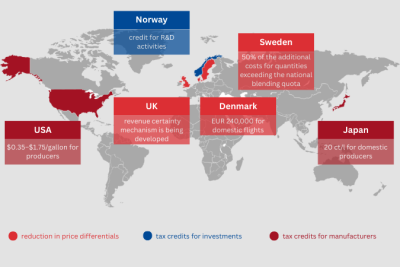
Overview of measures to reduce the SAF price differential and tax incentives
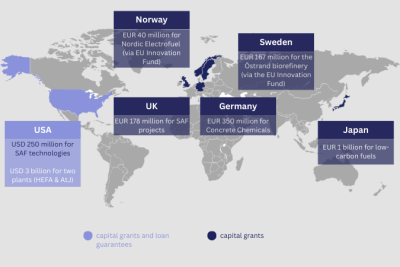
Capital grants and loan guarantees to promote sustainable aviation fuels
Further financial measures to increase the SAF offering are as follows:
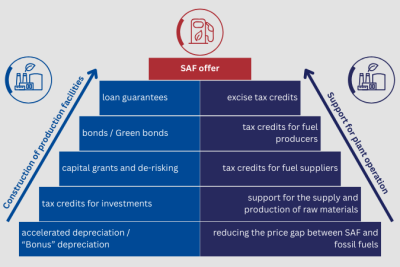
Promotional measures to increase the supply of SAF
In addition to financial incentives, simplifying regulatory approval procedures can make a significant contribution to speeding up the construction of production facilities, thereby driving forward the scaling up of SAF production.
The market for SAF needs clear regulations
Measures to increase supply and generate demand can be complemented by establishing a market for SAF. Clear and recognized framework conditions are of central importance for this. This includes the establishment of sustainability standards and methods for determining life cycle GHG emissions for the certification of raw material supply and fuel production. Existing systems, such as the ISCC (International Sustainability & Carbon Certification) or the REDcert-EU system, could be recognized for SAF production where possible.
Another component in establishing a market for SAF could be the introduction of a so-called “book and claim” mechanism. This system allows for virtual trading of SAF, whereby the environmental benefits are recognized regardless of physical use. This means that SAF can be refueled in one place in the world and credited in another. Book & Claim avoids dependencies on local fuel suppliers and additional costs for SAF transport. Such a model could also increase the willingness to enter into long-term purchase agreements.
The introduction of environmental labels, for example in accordance with the ReFuelEU Aviation Regulation, provides passengers with reliable information about the sustainability of the flights on offer. Such labels make the emission reductions achieved through the use of SAF directly visible to passengers.
Supporting the qualification of new SAF production pathways will enable the range of SAFs on offer to be expanded. In addition, SAF initiatives by interest groups in the aviation industry can also be supported. For example, the German initiative aireg (Aviation Initiative for Renewable Energy in Germany e.V.) is committed to aviation fuels from Renewable energies.
Initial successes: SAF usage increased to over 300,000 tonnes in 2023
The global use of SAF has grown steadily in recent years, with European airlines being the largest consumers to date. In 2023, Air France-KLM, DHL Group, and IAG each refueled between 50,000 and 90,000 tonnes of SAF. These quantities correspond to 0.7 to 3.3% of the annual Kerosene requirements of the airlines mentioned. US airlines are also catching up in terms of SAF volumes used, reaching a total of 46,000 tonnes in 2023. Airlines in Australia, Canada, Scandinavia, and Asia have only used SAF in smaller quantities of a few hundred to a maximum of 10,000 tonnes by 2023.
More information


Quoten:
- European Union (2023): https://eur-lex.europa.eu/legal-content/EN/TXT/?uri=CELEX%3A32023R2405&qid=1700480508227
- Reuter (2024): https://www.reuters.com/business/energy/south-korea-plans-mix-sustainable-aviation-fuel-international-flights-2027-2024-08-30/
- UK Government (2024): https://www.gov.uk/government/publications/about-the-saf-mandate/the-saf-mandate-an-essential-guide
- Government of British Columbia (2025): https://www2.gov.bc.ca/gov/content/industry/electricity-alternative-energy/transportation-energies/renewable-low-carbon-fuels/requirements
- Civil Aviation Authority of Singapore (n.D.): https://www.caas.gov.sg/docs/default-source/default-document-library/annex-1---blueprint-report-exec-summary.pdf
- RTI (2025): https://de.rti.org.tw/news/view/id/2009128
- Argus (2024): https://www.argusmedia.com/en/news-and-insights/latest-market-news/2609725-indonesia-to-require-saf-for-flights-from-2027
- ICAO (n.D.): https://www.icao.int/environmental-protection/SAF/Pages/Policies.aspx
- Treasury Board of Canada Secretariat (2025): https://www.canada.ca/en/treasury-board-secretariat/services/innovation/greening-government/low-carbon-fuel-procurement-program.html
Financing USA:
- Loan guarantees: Alternative Fuels Data Center: Grants for sustainable aviation fuels (SAF)
- Tax credits: Alternative fuels Data Center: Tax credit for the production of clean fuels
Financing Europe:
- UK Government (2025): https://www.gov.uk/government/publications/advanced-fuels-fund-competition-winners/advanced-fuels-fund-aff-competition-winners
- ICAO (n.D.): https://www.icao.int/environmental-protection/Documents/SAF/Guidance%20on%20SAF%20policies%20-%20Version%203.pdf
- Avinor (2024): https://avinor.no/globalassets/_konsern/barekraft/rapporter/framework-conditions-for-saf-in-norway.pdf
- European Commission (2024): https://ec.europa.eu/commission/presscorner/detail/en/ip_24_6435
- Swedavia Airports (2025): https://www.swedavia.com/globalassets/flygmarknad/for-2025/saf-incentive-programme-2025.pdf
- Invest in Denmark (n.D.): https://investindk.com/insights/denmark-launches-plan-to-make-domestic-aviation-sustainable
- UK Government (2024): https://www.gov.uk/government/consultations/sustainable-aviation-fuels-revenue-certainty-mechanism-revenue-certainty-options
Financing Other:
- Argus (2023): https://www.argusmedia.com/en/news-and-insights/latest-market-news/2518984-japan-proposes-tax-credits-for-ev-saf-investment
- Green Japan (n.D.): https://green-innovation.nedo.go.jp/en/project/development-fuel-manufacturing-technology-co2/summary/
SAF purchase quantity: