
© AdobeStock

CORSIA - Carbon Offsetting and Reduction Scheme for International Aviation

The CO2 compensation system in international aviation

In order to reduce climate-relevant emissions in aviation, the International Civil Aviation Organization (ICAO) set a target back in 2010 to keep COemissions stable from 2020 onwards. As a result, CORSIA – the Carbon Offsetting and Reduction Scheme for International Aviation – was adopted: a global measure to limit CO2 emissions from international aviation. CO2 emissions are to be offset by investing in climate protection projects outside the aviation sector.

CORSIA as a global measure for CO2-neutral growth in aviation

CORSIA is a market-based Climate Compensation system developed in 2016 in response to the growth of the aviation industry and the associated increase in CO₂ emissions. It is based on the emission level, which is the average CO₂ emissions generated by international aviation in 2019-2020. Emissions that exceed the base year level must be offset. 


Airlines worldwide invest in projects that offset emissions on a scale equivalent to their own CO₂ emissions. Under CORSIA, CO₂ emissions are offset by financing CO₂-reducing climate protection projects outside the aviation sector.

Phased introduction of CORSIA

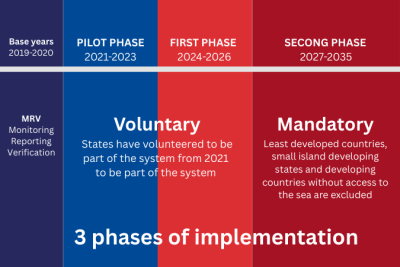
CORSIA will be implemented in several phases:

  • Since 2019: Mandatory reporting (monitoring, reporting, and verification, MRV) of CO₂ emissions for international flights of all ICAO member states
  • Pilot phase (2021–2023): Voluntary participation by states
  • First phase (2024–2026): Voluntary participation by selected countries
  • Second phase (2027–2035): Mandatory participation for all ICAO member states. Exceptions are least developed countries (LDCs), small island developing states (SIDS), and landlocked developing countries (LLDCs).
Infographic on the implementation timeline for the international CORSIA system.
© CENA Hessen

Three phases of the implementation of CORSIA, based on ICAO (2022) and ICAO (2023)

As of 2025, 129 countries have already committed to voluntary participation.

Scope of CORSIA: Who has to offset which emissions?

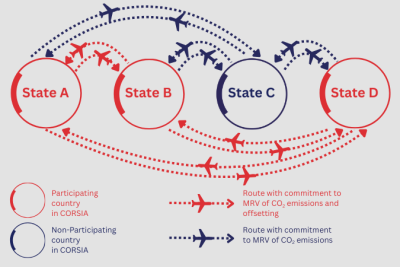
CORSIA applies to all civil international flights between two participating countries. Airlines operating these routes are required to offset CO₂ emissions for the flight route that exceed the defined baseline level.

Diagram showing four countries illustrating the application of CORSIA. Red countries participate in the system, blue countries do not. Red flight routes show routes with CO₂ measurement, reporting, verification, and offset obligations (MRV + offset), blue lines show only MRV obligations. The different obligations depending on the combination of departure and destination countries are shown.
© CENA Hessen

Scope of CORSIA, based on ICAO (2022)

Two approaches are used to calculate Compensation: the sectoral approach and the individual approach.

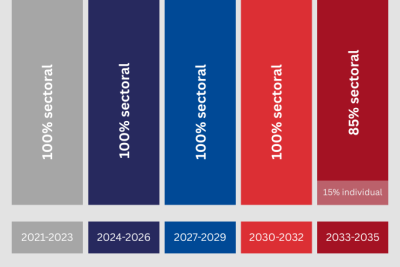
  • Sectoral approach: Until 2030, compensation will be based on a sectoral approach, whereby the average global CO₂ growth rate is applied to the respective airlines. The growth of individual airlines is not taken into account. This means that airlines that grow less than the global average pay more compensation than they actually cause in CO₂ emissions.
  • Individual approach: From 2030, there will be a gradual transition to an individual approach, in which each airline compensates based on its actual CO₂ emissions.
Bar chart showing the development of CORSIA. From 2021 to 2032, CO₂ offsetting will be entirely sector-based. From 2033 onwards, 15% of commitments will be calculated on an individual airline basis, with 85% remaining sector-based. The chart shows the gradual transition over five time periods.
© CENA Hessen

Transition from a sectoral to an individual remuneration approach within the system of CORSIA, based on ICAO (2023)

Sustainable aviation fuels (SAF) as an option for CO2 offsetting

In addition, CORSIA allows the Compensation obligation to be reduced through the use of sustainable aviation fuels (SAF) and low-carbon aviation fuels (LCAF). For such a fuel to be eligible under CORSIA, it must be certified as a CORSIA Eligible Fuel (CEF). This requires compliance with certain sustainability and manufacturing requirements in accordance with the ICAO Sustainability Certification Scheme (SCS). These include, for example, standard values for life cycle emissions and manufacturing in accordance with ASTM-certified processes.

More information

Accelerating the SAF market ramp-up

International and national incentives and promotion measures to accelerate the ramp-up of the SAF market

EU regulations for SAF

Sustainable aviation fuels in the EU: key regulations, quotas, and policy instruments

Global climate protection instruments

A comparison of the global EU ETS and CORSIA programs: opportunities and challenges

SAF regulation in Germany

Sustainable aviation fuels in Germany: an overview of the most important laws and regulations