
While intra-European aviation is already included in the European Emissions Trading System (EU ETS), additional rules have been in place since 2025 to make aviation more sustainable. An initial sustainable aviation fuel (SAF) quota of 2% will come into force, rising to 70% by 2050. The quota can be met by biofuels or synthetic aviation fuels, which must meet specified sustainability criteria.
Overview of requirements for sustainable aviation fuels in the EU
Quotas and sustainability criteria
Aviation in the European Emission Trading Scheme
The European Green Deal aims to make the economy and society climate-neutral by 2050. A central instrument is the European Emissions Trading System. Intra-European aviation has been included in the EU ETS since 2012, and free certificates will be phased out until 2027.
The EU ETS requires airlines to purchase allowances for their CO₂ -emissions. One allowance is needed for every ton of CO₂ emitted - the total number of allowances available is limited and declining each year. The system thus creates a financial incentive to reduce emissions and use more climate-friendly technologies. From 2025, the EU ETS will also require reporting on the non-CO2 effects of aviation.
70% SAF by 2050 – half of it e-kerosene
The ReFuelEU Aviation Directive describes a gradual increase in the share of SAF at EU airports. By 2025, at least 2% of the aviation fuel provided in the EU must come from sustainable sources. This share will increase steadily to 70% by 2050.
An important aspect of this directive is the support of e-fuels. These are made from hydrogen and CO2. The ReFuelEU Aviation requires that at least 1.2% of aviation fuel must come from synthetic sources by 2030. This will increase to 35% by 2050. In this way, the EU wants to ensure that not only bio-based, but also electricity-based aviation fuels are supported.
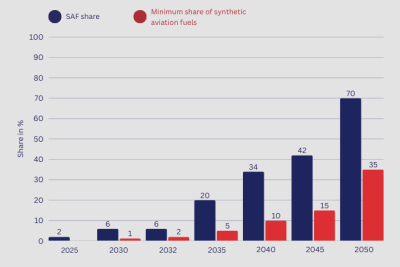
ReFuelEU Aviation quotas for sustainable aviation fuels
*For 2030 & 2031 the average share must be 1.2%. For the period from 2032 up to and including 2034, the average share must be 2%. The remaining shares relate to one calendar year. The directive describes the fulfillment of the SAF quotas per airport. However, up to and including 2034, a transitional arrangement will apply, meaning that the quotas will also be deemed to have been met if they are met on average across the EU. This means that when some airports exceed the quotas, other airports are allowed to fall short of the quotas for SAF (flexibility mechanism).
Eligibility of various aviation fuels for the SAF-quota
There are different possibilities to meet the quota:
- Aviation biofuels, produced with sustainable biomass
- Recycled carbon aviation fuels, produced with e.g., gas from waste processing
- Synthetic aviation fuels, produces from CO2 and renewable hydrogen
- Renewable hydrogen, produced with renewable electricity
- Low-carbon hydrogen, produced with electricity from nuclear power
- Synthetic low-carbon aviation fuels, produced with low-carbon hydrogen
Consequences for airlines and aviation fuel suppliers
The new requirements have far-reaching consequences:
- Aviation fuel suppliers have to increase their production capacities for SAF to meet the increasing quotas.
- Airlines have to prepare for rising fuel prices as SAF production is more expensive than production of conventional Kerosene.
Consequences of failure to meet quotas
The ReFuel EU Aviation directive describes that fines will be imposed if the quotas are not met. If the quotas are not met, the member states are obliged to impose fines (ReFuelEU Aviation § 12). A distinction is made between airlines, managing bodies of EU airports and aviation fuel suppliers.
The exact amount of these fines is determined by the individual member states, although minimum amounts are specified in the directive. Missing quantitates must be supplied by aviation fuel suppliers in the following year.
In addition, an obligation to refuel is established to prevent circumvention of the quotas through changes in refuelling behavior (anti-tankering). This means that airlines must actually refuel at an EU airport for at least 90% of their annual requirements for flights departing from EU airports.
RED II & III: What characterizes SAF
Not every alternative aviation fuel is recognized as SAF in the EU. The Renewable Energy Directives (RED II and RED III) (and their delegated regulations) set out detailed criteria to ensure that only environmentally friendly options are supported.
Criteria for the use of aviation biofuels
- To produce so called “Advanced Biofuels” only feedstocks that are listed in Part A of Annex IX of the Renewable Energy Directive are allowed:
- Algae if cultivated on land in ponds or photobioreactors
- Biomass fraction of mixed municipal waste
- Biowaste from private households that is collected separately
- Biomass fraction of industrial waste not fit for use in the food or feed chain
- Straw
- Animal manure and sewage sludge
- Palm oil mill effluent and empty palm fruit bunches
- Tall oil pitch
- Crude glycerine
- Bagasse
- Grape marcs and wine lees
- Nut shells
- Husks
- Cobs cleaned of kernels of corn;
- Biomass fraction of wastes and residues from forestry and forest-based industries
- Other non-food cellulosic material
- Other ligno-cellulosic material except saw logs and veneer logs.
- Fusel oils from alcoholic distillation
- Raw methanol from kraft pulping stemming from the production of wood pul
- intermediate crops, such as catch crops and cover crops that are grown in areas where due to a short vegetation period the production of food and feed crops is limited
- Crops grown on severely degraded land, except food and feed crops
- Cyanobacteria
2. Additionally, biomass specified in Part B of Annex IX of the Renewable Energy Directive is allowed for production of biofuels for transport:
- Used cooking oil
- Animal fats (Only byproduct)
- Damaged crops that are not fit for use in the food or feed chain
- Municipal wastewater and derivatives other than sewage sludge
- Crops grown on severely degraded land excluding food and feed crops and feedstock
3. Biomass that is not food or feed and meets other sustainability and greenhouse gas reduction criteria (§ 29 RED II): The required greenhouse gas reduction depends on the age of the production facility and ranges from a minimum of 50% to 65%. The sustainability criteria are intended to prevent the degradation of ecosystems. Biomass in this third category may contribute a maximum of 3% to the SAF quota.
Criteria for the use of synthetic aviation fuels
Synthetic aviation fuels, also known as e-fuels, must guarantee a greenhouse gas reduction of at least 70%. To achieve this, the electricity must come from renewable sources. Under these conditions, electricity is considered to be fully renewable (delegated regulation (EU) 2023/1184):
Direct connection to renewable energy plant:
Additionality:
The electricity for e-fuels must come from additionally built renewable energy plants. This is intended to prevent the demand for fossil electricity from increasing.
Electricity taken from the grid:
- Electricity purchased from a grid with a renewable energy share of over 90%.
- Electricity taken from a grid with an emissions intensity of less than 18 g CO2/ MJ. In addition, e-fuels may only be produced if renewable electricity is available at that time and in the same area. This is referred to as temporal and geographical correlation.
- Power Purchase Agreement (PPA) and fulfillment of additionality (from 2028) as well as temporal and geographical correlation.
- Surplus electricity from Renewable energies.
In principle, it is possible to use CO2
from all conceivable sources as long as the synthetic aviation fuel achieves a greenhouse gas saving of at least 70%. CO2 from the following CO2
sources is considered to be avoided CO2 and contributes to achieving the greenhouse gas savings (delegated regulation (EU) 2023/1185):
- CO2 from industrial processes before 2041. An exception is CO2 from combustion of fuels for electricity generation. Its usage is only allowed before 2036.
- CO2, captured from air (Direct Air Capture, DAC)
- CO2 from the production or the combustion of biofuels
- CO2 from the combustion of e-fuels
- CO2 from a geological source that was released naturally
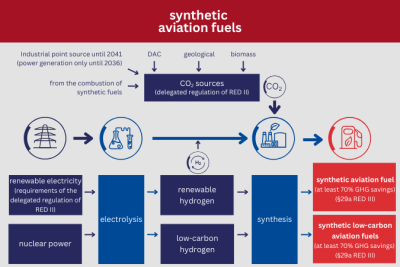
Synthesis route for Synthetic fuels
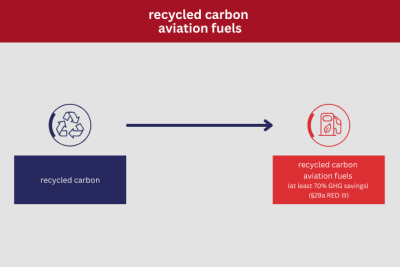
Synthesis route for recycled carbon aviation fuels
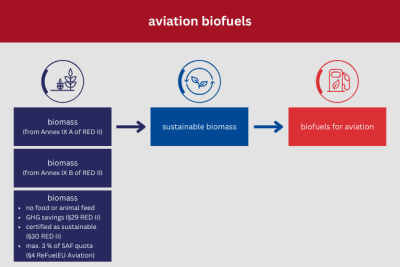
Synthesis route for biogenic aviation fuels
More information

European Union (2018): https://eur-lex.europa.eu/legal-content/DE/TXT/PDF/?uri=CELEX:32018L2001
European Union (2023): https://eur-lex.europa.eu/legal-content/DE/TXT/PDF/?uri=OJ:L_202302413
European Union (2023): https://eur-lex.europa.eu/legal-content/DE/TXT/PDF/?uri=CELEX:32023R1184
European Union (2023): https://eur-lex.europa.eu/legal-content/DE/TXT/PDF/?uri=CELEX:32023R1185
European Union (2024): https://eur-lex.europa.eu/legal-content/DE/TXT/?uri=LEGISSUM%3A4714799
European Union (2024): https://eur-lex.europa.eu/DE/legal-content/summary/renewable-energy.html