
In order to limit the impact of aviation on the climate, CO2 emissions must be reduced and offset. Two market-based instruments with different effects are available for this purpose: the European Emissions Trading System (EU ETS) and the Carbon Offsetting and Reduction Scheme for International Aviation (CORSIA).
Global programs for reducing greenhouse gases in aviation
EU ETS and CORSIA in comparison – opportunities and challenges for more sustainable aviation
EU ETS: Trading CO2 certificates
The European Emissions Trading System (EU ETS) is the central European climate protection instrument. Its goal is to achieve a 90% reduction in greenhouse gas emissions by 2040 compared to 1990 levels. It was introduced in 2005 to implement the goals of the international Kyoto Protocol in more than 30 European countries.
In addition to the 27 EU member states, Norway, Iceland, and Liechtenstein have also joined the system. The EU ETS covers the electricity, heat generation, energy-intensive industrial sectors, aviation, and, since the last revision, maritime transport. Together, these sectors account for around 40% of the EU's total CO2 emissions.
The “cap and trade” approach: reducing and trading greenhouse gas emissions
The EU ETS takes a market-based approach to setting a price for carbon dioxide (CO2) emissions. Companies covered by the EU Emissions Trading System are required to monitor and report their emissions each year and to purchase or trade sufficient allowances to cover their annual emissions. Those who emit less can sell surplus allowances, while those who emit more must purchase additional allowances. The total amount of allowances available is gradually being reduced, so that emissions must decrease in the long term. The aim is to reduce emissions where it is most efficient to do so, thereby effectively combating climate change.
The cap-and-trade principle forms the basis of the EU ETS. It sets an annual cap on the total amount of greenhouse gas emissions allowed for certain economic sectors, including aviation. This cap is converted into tradable emission allowances, which are issued to market participants through free allocation or auctioning. One allowance entitles the holder to emit one tonne of CO2 (or its equivalent) during a specific period. From 2026 onwards, there will be no more free allocation for aviation, with the exception of the use of SAF.
Billions in revenue to promote climate-friendly technologies
Member states must earmark the proceeds from auctioning for specific purposes, such as climate protection or social Compensation. In Germany, the proceeds from emissions trading go into the Climate and Transformation Fund (Klima- und Transformationsfonds, KTF). Among other things, the fund finances energy efficiency and renewable energy measures in the building sector and supports industry in Decarbonization and the use of hydrogen.
At the European level, the EU Innovation Fund is an important source of EU support for new carbon capture projects and innovative low-carbon technologies and processes in energy-intensive industries. Between 2020 and 2030, the Emissions Trading System will provide around €38 billion from the auctioning of EU ETS allowances to the Innovation Fund.
EU ETS applies only to flights within the EEA
The EU ETS currently only applies to flights taking off or landing within the territory of the European Economic Area (EEA). Exemptions exist for operators with less than 10,000 tonnes of annual CO2 emissions and for aircraft with a maximum gross weight of 5.7 tonnes, as well as for certain flights, such as rescue missions.
The United Kingdom and Switzerland are also integrated into the European emissions trading system, with flights to these countries subject to the EU ETS, while flights from these countries are subject to their respective national emissions trading systems.
Consideration of non-CO2 effects from 2025 onwards
From 2025 onwards, other emissions from aviation, known as non-CO2 effects, will be included in the EU ETS alongside carbon dioxide. This will include, for example, the release of nitrogen oxides, soot particles, and oxidized sulfur compounds during fuel combustion, as well as the effects of water vapor, including Contrails. Initially, this will be done by monitoring non-CO2 emissions, and later possibly also through a requirement to surrender emission allowances.
CORSIA: Offsetting growth-related emissions in aviation
In order to limit the increase in CO₂ emissions in international aviation, the International Civil Aviation Organization (ICAO) has launched the Carbon Offsetting and Reduction Scheme for International Aviation (CORSIA). It aims to ensure that emissions exceeding the baseline of 85% of 2019 CO₂ emissions are offset by climate protection projects. The idea behind this is the principle of “CO₂ neutral growth,” which means that airlines must pay for additional emissions in order to offset them elsewhere. This is an important interim step until sustainable aviation fuels (SAF) and low-emission propulsion technologies are sufficiently developed to directly reduce emissions.
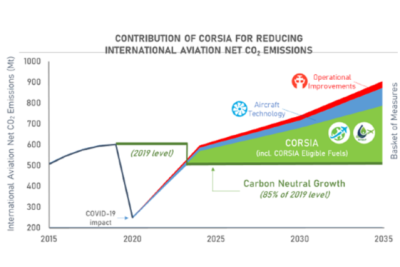
CORSIA's contribution to reducing CO₂ emissions in international aviation
CO2 compensation through verified climate protection projects
CORSIA works on the principle of emissions offsetting: airlines flying international routes must calculate their CO₂ emissions and offset them in certain phases. Offsetting is achieved by purchasing CO₂ certificates from verified climate protection projects that support, for example, reforestation, Renewable energies, or CO₂ storage. The program is being implemented in phases: Since 2021, countries have been able to participate voluntarily, and from 2027, CORSIA will be mandatory for almost all international flights. Airlines must also report their emissions regularly to ensure transparency.
Valid for (almost) all international flights from 2027 onwards
CORSIA applies to international flights, i.e. air traffic between two countries. Domestic flights are not affected, as these often fall under national climate policy. Currently, over 100 countries are voluntarily participating in CORSIA, including the EU member states and the US. From 2027, the program will become mandatory for all ICAO member states with relevant air traffic.
Critics argue that CORSIA alone is not enough to make aviation climate-friendly, as it does not enforce direct emissions reductions, but only creates offsets through external climate protection projects. Nevertheless, it is a significant step toward making air travel more climate-friendly until sustainable propulsion systems and Alternative fuels can be used more widely.
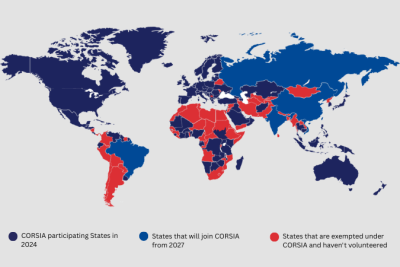
CORSIA participating countries
EU ETS compared to CORSIA
Focus on different goals
The cap-and-trade principle means that the emissions cap for air traffic in the EU is being continuously lowered. Since 2021, the cap has been reduced by 2.2% annually, and from 2024 and 2028, the annual reduction will be 4.3% and 4.4% respectively. CORSIA, on the other hand, is significantly less ambitious in terms of CO2 reduction targets. This is mainly because CORSIA only aims for CO2-neutral growth from 2020 onwards, with emissions not falling below 85% of 2019 levels in the long term.
The extent to which emissions in aviation are actually reduced will also depend on the expected price of CO2 emission allowances in the EU ETS and CO2
offsetting via CORSIA. In recent years, there has been a significant increase in the price of CO2 emission allowances in the EU. Eligible CO2 certificates for CORSIA are currently significantly below this level.
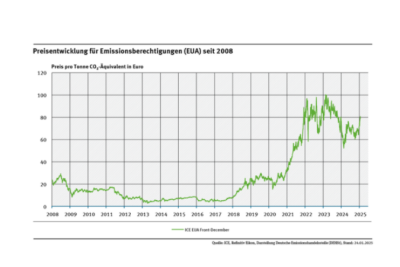
Price trends for emission allowances in the EU
Avoiding double obligations in the EU
CORSIA is being implemented via the EU to ensure rapid and uniform implementation in all member states. The monitoring methods for the EU ETS and CORSIA have been harmonized so that airlines must demonstrate a uniform monitoring concept for both systems.
CO2 emissions from flights are subject to different rules depending on the flight route. The temporary restriction of the EU ETS to routes within and between EEA countries in accordance with the “reduced scope” will expire at the end of 2026. This means that from 2027, all flights taking off or landing in the European Economic Area will fall under either CORSIA or the EU ETS. Only domestic flights in non-EEA countries and flights to and from certain developing countries are exempt from both obligations.
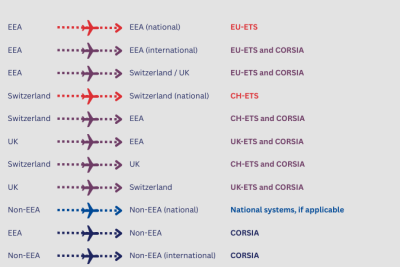
Scope of application of EU ETS and CORSIA
More information

EU ETS
- European Union (2008): https://eur-lex.europa.eu/eli/dir/2008/101/oj/eng
- European Comimission (o.D.): https://climate.ec.europa.eu/eu-action/climate-strategies-targets/2040-climate-target_en
- Federal Environment Agency (2025): https://www.umweltbundesamt.de/daten/klima/der-europaeische-emissionshandel#teilnehmer-prinzip-und-umsetzung-des-europaischen-emissionshandels
- German Bundestag (2024): https://www.bundestag.de/presse/hib/kurzmeldungen-1015396
- German Emissions Trading Authority (2024): -1/Luftverkehr/Anwendungsbereiche/anwendungsbereiche_artikel.html">https://www.dehst.de/DE/Themen/EU-ETS-1/Luftverkehr/Anwendungsbereiche/anwendungsbereiche_artikel.html
- German Emissions Trading Authority (2024): https://www.dehst.de/SharedDocs/Newsletter/DE/2024/2024-11-14-international-newsletter-08-nicht-co2-effekte.html
CORSIA:
- IATA (2024): https://www.iata.org/contentassets/fb745460050c48089597a3ef1b9fe7a8/corsia-handbook.pdf
- IATA (2025): https://www.iata.org/en/iata-repository/pressroom/fact-sheets/fact-sheet-corsia/
- ICAO (2025): https://www.icao.int/environmental-protection/CORSIA/Pages/default.aspx
- German Emissions Trading Authority (o.D.): https://www.dehst.de/SharedDocs/downloads/EN/publications/factsheets/factsheet_CORSIA_EU_ETS.pdf?__blob=publicationFile&v=1#:~:text=CORSIA%20is%20part%20of%20a,based%20climate%20change%20mitigation%20measure.
- Federal Environment Agency (2023): https://www.umweltbundesamt.de/sites/default/files/medien/11850/publikationen/09_2023_factsheet_luftverkehr_im_ets_und_corsia.pdf