
Sustainable aviation fuels (SAFs) are considered a key solution for decarbonising air transport. The sustainability of individual types of SAF depends on how they are produced. The production process and the feedstock used determine their environmental impact, economic efficiency and technical performance. This article explores the most promising SAF production routes in the short and long term.

A comparison of sustainable aviation fuels
SAF under scrutiny – the potential for implementing the technologies
Advantages and disadvantages from an ecological perspective
Although SAFs are a sustainable alternative to fossil Kerosene, not all SAFs are equally environmentally sustainable. Their environmental and Climate impact varies greatly depending on the manufacturing process, the feedstock used, and the energy required for processing. Notably, there are large differences in terms of CO₂ savings potential, land use, and water requirements.
E-kerosene scores highly in terms of climate protection and greenhouse gas reduction
Combusting fossil Kerosene produces a lot of CO₂. Depending on the type of sustainable aviation fuel (SAF), up to approximately 95% of this can be saved. Kerosene produced from green electricity and carbon dioxide via the Fischer–Tropsch process (power-to-liquid, PtL) has the lowest CO₂ footprint of all SAF types.
However, bio-kerosene produced using the HEFA process from used cooking oil or animal fats has a larger carbon footprint. HEFA produced from vegetable oils, such as palm or soybean oil, has the highest emissions due to agricultural emissions.
The carbon footprint of the alcohol-to-jet (AtJ) process lies between those of the FT and HEFA processes. If the alcohol is obtained from waste materials rather than starch- and sugar-containing plants, the carbon footprint is lower.
Currently, there is little reliable data available for the methanol-to-jet (MtJ) process.
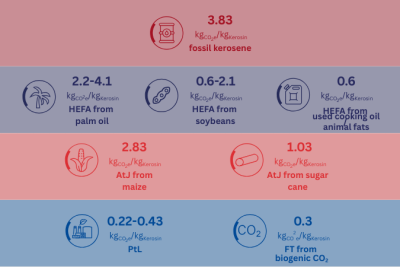
Comparison of emissions from fossil and sustainable Kerosene types, Sources: Federal Environment Agency (2022) and Prussi et al. (2021)
Bio SAF requires more land and water
In addition to Greenhouse gases, the ecological assessment of SAFs is also greatly impacted by land use, water consumption and feedstock availability.
SAFs' water consumption is often underestimated; biogenic processes in particular have a high water footprint due to the intensive nature of the agriculture required. Synthetic SAFs, on the other hand, have comparatively low water requirements.
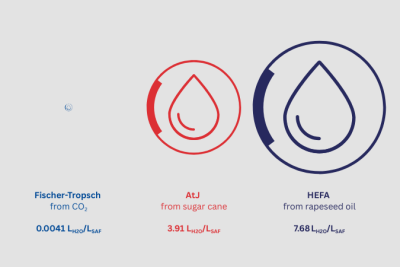
Water consumption of different SAF production processes, Source: Federal Environment Agency (2022)
The HEFA process, which is based on waste products such as used cooking oil, is relatively sustainable. However, there is one major disadvantage: waste materials are not infinitely scalable and are therefore limited in quantity. Using plant-based oils, such as palm or soybean oil, can lead to competition with food production for land use and indirect land use changes. The same applies to ATJ SAFs if the alcohol is obtained from crops such as corn or sugarcane.
Similar to the HEFA process, FT and MtJ fuels derived from residual and waste biomass are considered environmentally friendly because they do not require additional land and avoid indirect land use changes. However, they too are limited in quantity. FT-SAFs, which use CO₂ from direct air capture or industrial point sources, are even more favourable in terms of land use; however, they require a significant amount of renewable energy.
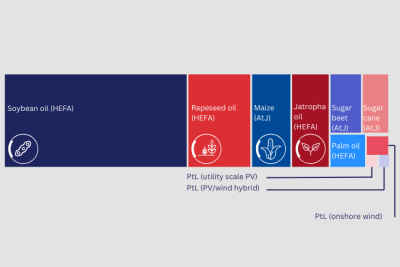
Area required to produce one ton of SAF per year, Source: Federal Environment Agency (2022)
Advantages and disadvantages from an economic perspective
For SAFs to be widely used, their environmental footprint and contribution to the decarbonisation of aviation are not the only decisive factors; they must also be economically viable to produce. A key factor here is how ready the technologies are for the market, which varies greatly depending on the type of SAF.
High production costs are a challenge for sustainable aviation fuels, especially synthetic SAFs
depending on the manufacturing process and the type of feedstock used. Currently, bio-SAF is the most cost-effective option, as HEFA technology is well established and used cooking oil is inexpensive as a feedstock. AtJ and MtJ have higher production costs due to the need for additional process steps. The Fischer–Tropsch synthesis for E-kerosene is even more costly because it requires expensive reactor technology. Consequently, the average production cost of e-SAF is around 7,700 euros per tonne. However, the price of FT-SAF varies greatly from region to region as it depends on electricity prices and the cost of the CO₂ source.
Overall, therefore, SAFs are significantly more expensive than fossil kerosene, which has an average market price of around 740 euros per tonne. It should be noted, however, that economies of scale can significantly reduce production costs and have a major impact on the economic viability of SAFs: the maturation or Market ramp-up of the technologies can achieve this. Nevertheless, market ramp-up is severely hindered by a lack of demand from airlines due to high costs and financing uncertainties for investors.
Distribution/production costs (EASA):
7700
Euro/tonne
for e-SAF
740
Euro/tonne
for fossil kerosene
2100
Euro/tonne
for Bio-SAF
Market readiness of technologies – HEFA as a pioneer
Technical maturity is a key factor in investment decisions and political subsidies, and is therefore essential for the Market ramp-up of sustainable aviation fuel (SAF). Mature processes offer greater investment security. Less well-established production methods, on the other hand, carry a significantly higher risk, despite offering attractive long-term potential. The Technology Readiness Level (TRL) is a classification system that describes the maturity of a process on a scale from 1 (basic research) to 9 (fully established in industry).
The HEFA process can be used on an industrial scale with used cooking oil and other established biogenic oils as feedstock. With a TRL of 9, it is the most advanced process in economic and technological terms, and is already well-established in the market. The HC-HEFA variant, which is based exclusively on microalgae, has been validated but not yet demonstrated. It is significantly less mature, which is why it is still in the TRL range of 4–5. The alcohol-to-jet (ATJ) process is also at different stages of development depending on the feedstock used. The ATJ process using sugar/starch has a TRL of 8–9. For lignocellulosic feedstocks, such as wood, the TRL is 7–8 because the conversion process is more complex.
The manufacturing processes for synthetic sustainable aviation fuels (SAFs) are not yet as technically mature as those for biogenic fuels. Although pilot and demonstration plants for producing SAF using Fischer–Tropsch synthesis (FT-SPK) already exist, large-scale implementation is still pending. In this context, the large-scale reverse water gas conversion reaction (RWGS) has emerged as a critical technical element. The TRL of the FT process is therefore still in the range of 5–7. The MtJ process is relatively new, but depending on the design of the process, the TRL is already between 7 and 8.
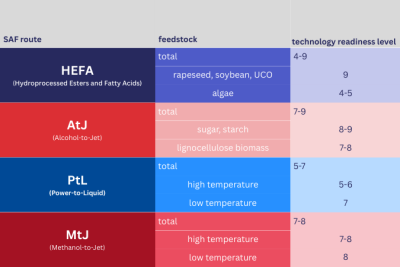
Overview of SAF production pathways and their technology readiness level (TRL), Source: Federal Environment Agency (2022)
Advantages and disadvantages from a technical perspective
Regardless of its ecological and economic sustainability, an aviation fuel must be technically safe. This is ensured by ASTM approval. In addition, the fuel must be drop-in compatible, enabling it to be used in existing aircraft fleets and infrastructures. Crucial technical properties in this regard include energy content, aromatic content, low-temperature behaviour and combustion properties. Depending on the production process, sustainable aviation fuel (SAF) can affect performance, emissions and handling differently.
Hardly any differences in energy content and calorific value
The energy content, or calorific value, of a fuel indicates the amount of energy available per kilogram of fuel. Therefore, a high calorific value is necessary to provide as much propulsion energy as possible while keeping the weight as low as possible. This is particularly important in aviation, where aircraft must remain airworthy despite the weight of the fuel.
Chemically, sustainable aviation fuels (SAFs) are liquid hydrocarbons, just like fossil Kerosene. The energy content of hydrocarbons depends on chain length: shorter chains have a lower calorific value. SAFs have a comparable chain length to fossil kerosene, containing eight to sixteen carbon atoms, meaning their energy content is similar to that of fossil kerosene at around 43 MJ/kg. Consequently, there are no significant differences in terms of engine performance or suitability for long-haul flights. In terms of energy content, SAF can therefore easily substitute fossil kerosene.
Aromatic additive for better material compatibility despite climate-damaging combustion
A key factor in the technical evaluation of aviation fuels is their aromatic content. This affects the way they burn and how they interact with the engine's materials. While fossil Kerosene typically contains around 20% Aromatics, sustainable aviation fuels (SAFs) have a significantly lower aromatic content. Consequently, SAFs burn more cleanly than fossil kerosene, producing less soot and particulate matter. This improves local air quality and reduces Non-CO₂ effects. However, aromatics fulfil an important technical function in aircraft engines in that they cause seals to swell. Therefore, too low an aromatic content can cause leaks, which is why the addition of low-aromatic SAFs is currently only permitted to a limited extent. To address this, aromatic variants of SAFs, such as FT-SPK/A or ATJ-SKA, have been developed to enable the substitution of fossil kerosene without issue. These are then retrofitted with aromatics to meet the technical requirements.
Combustion properties & engine compatibility
In addition to material compatibility, Aromatics influence atmospheric effects, particularly climate-relevant Non-CO₂ effects such as Contrails. Kerosene with a high aromatic content, such as fossil Jet A-1 or aromatic sustainable aviation fuels (SAFs), promotes contrail formation through incomplete combustion and the associated formation of soot particles. Conversely, low-aromatic or aromatic-free SAFs cause fewer or weaker contrails and significantly reduce climate-relevant non-CO₂ effects.
Contrails have a high global warming potential; in some cases, this is greater than that of CO₂. While they have a cooling effect during the day (reflecting some of the incoming sunlight), they absorb infrared radiation (heat radiation from the Earth) at night. Consequently, they have an overall warming effect.
Contrails are made up of ice crystals and are formed when aviation fuel is burned.
- The combustion of kerosene produces carbon dioxide (CO₂) and water vapour.
- At high altitudes and low temperatures, the water vapour condenses on soot particles.
- These particles then act as nuclei for ice crystals to form around.
- Contrails form.
Therefore, aromatic aviation fuels greatly increase the formation of contrails, and consequently the non-CO₂ effects, through the formation of soot particles, which serve as crystallisation nuclei.
Viscosity and low-temperature properties – Optimizing SAFs for better pumping and atomization behavior
During flight, aircraft and their fuel are exposed to extreme conditions. To ensure the safety of those on board, it is crucial that aviation fuels perform reliably in all situations. In particular, ambient temperatures as low as −50°C at typical cruising altitudes of over 10,000 metres can present a challenge to aviation fuels. If a fuel freezes or becomes too viscous, it cannot be pumped through pipes or atomised in the engine. To prevent such a scenario from having fatal consequences, strict requirements are placed on the properties of aviation fuels.
Most sustainable aviation fuels (SAFs) have a lower viscosity than fossil kerosene, which improves their flow behaviour in cold conditions. This is particularly true of SAFs with branched hydrocarbon chains, such as HEFA or FT. Branched chains are usually formed in a specific processing step (isomerisation) for this purpose. Although AtJ and MtJ are not specifically optimised for cold behaviour during processing, they still meet the ASTM D7566 standard limit values for the freezing point of aviation fuels.
Conclusion: The potential of SAF production routes
The various SAF production pathways have different strengths and challenges. In the short term, the HEFA process is the most attractive option as it has the lowest production costs and is both commercially available and technologically established. This makes it particularly suitable for a rapid Market ramp-up. In the medium term, AtJ could play an important role, but the major disadvantage is that it competes with food production if the feedstock comes from primary agricultural production.
From an ecological point of view, FTs have the greatest potential to prevail in the long term, although they are not yet fully established technologically. They offer the greatest potential for reducing CO2
emissions and do not cause indirect land use changes when using air-captured CO2. They are also easily scalable as long as sufficient renewable energy is available. Currently, however, production costs are still very high. FT fuels will only be able to establish themselves permanently on the market if the market ramp-up is successful and costs fall significantly.
To ensure full drop-in compatibility with SAFs, they can be modified by adding Aromatics, as with FT-SPK/A or ATJ-SKA. Reliable political framework conditions, targeted subsidies, and investments in infrastructure and technology development are, however, crucial for the market ramp-up of the various SAF production pathways.
More information


Prussi et. al. (2021): 10.1016/j.rser.2021.111398
Federal Environment Agency (2022): https://www.umweltbundesamt.de/sites/default/files/medien/376/publikationen/background_paper_power-to-liquids_aviation_2022.pdf