Sustainable aviation fuels (SAF) play a key role in the transition to more climate-friendly aviation. A reliable and sufficient supply of SAF is crucial if aviation is to effectively reduce its emissions. This article provides an overview of the development of SAF production up to 2030 and demand in Europe.
Global production and demand for sustainable aviation fuels
Overview of requirements, production volume, and expected demand development
Mandates for sustainable aviation fuels in the EU since 2025
The European ReFuelEU Aviation Regulation sets mandates for sustainable aviation fuels in order to gradually decarbonize air transport. Since 2025, fuel suppliers are required to blend a growing proportion of sustainable fuels with conventional Kerosene.
This SAF quota starts at 2% in 2025 and rises to 70% by 2050. In addition, a minimum quota for Synthetic fuels (e-SAF) will apply from 2030, starting at 1.2% and increasing to 35% by 2050. The calculation is based on total kerosene consumption in the EU. Fuel suppliers face penalties for non-compliance.
3.1 million tonnes of SAF and 0.6 million tonnes of e-SAF needed in 2030
In order to meet the SAF quota of 2% in 2025, around 1 million tonnes of SAF will be needed in the EU. For 2030, the EU requires a SAF quota of 6%, which corresponds to the required amount of around 3.1 million tonnes of SAF. Part of the specified SAF quota of 6% in 2030 must come from synthetic processes: the e-SAF sub-quota of 1.2% means that around 620,000 tonnes of SAF are to be produced from renewable electricity and CO₂ in 2030.
Global production volume of 35 million tonnes of SAF expected in 2030
In 2024, announced SAF production worldwide was around 2.6 million tonnes – an increase of 0.5 million tonnes compared to 2023. Around 1.5 million tonnes of this will be produced by the Finnish company Neste, which manufactures SAF at its production facilities in Rotterdam and Singapore. A significant expansion of production capacities is expected by 2030: according to current announcements, around 35 million tonnes of SAF are to be produced worldwide each year – more than thirteen times the amount produced in 2024.
In Germany, production volumes of 420,000 tonnes have been announced for 2030. The decentralised structure of SAF production remains striking. Instead of large, centralised locations, SAF is mainly produced in medium-sized or small plants distributed globally.
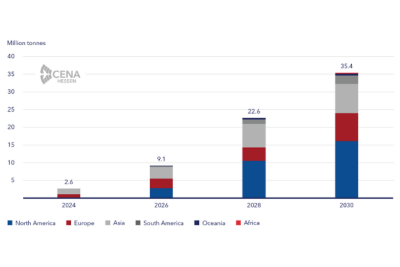
Announced SAF production volumes worldwide for 2024 to 2030
EU SAF quota realistically achievable – e-SAF targets not yet secured
With the currently announced production volumes from advanced projects (plants that are already in operation or under construction), it is realistic to expect that the EU SAF mandates for 2025 and 2030 will be met. According to current project announcements, the planned production capacities will be sufficient to meet the demand of around 1 million tonnes of SAF required to fulfill the SAF mandate in 2025. Based on current projects with a high probability of implementation, around 3.8 million tonnes of SAF could be produced within the EU by 2030. Overall, production capacities in Europe could even grow to up to 6.3 million tonnes per year by 2030. The majority of these volumes are expected to come from biogenic sources, in particular the established HEFA process.
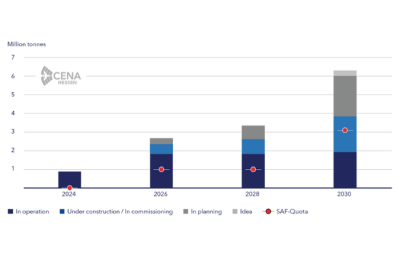
Production volumes compared to the SAF quota in the EU by project status
However, fulfillment of the e-SAF sub-quota of 1.2% from 2030 onwards is not guaranteed and depends on several large-scale projects. Currently, only a realistic e-SAF production volume of around 72,000 tonnes is expected in the EU for 2030. There are other project ideas with a potential of around 1.4 million tonnes, but most of these are still in the early planning stages or awaiting final investment decisions. Whether and when these capacities will actually be realized is still unclear at present.
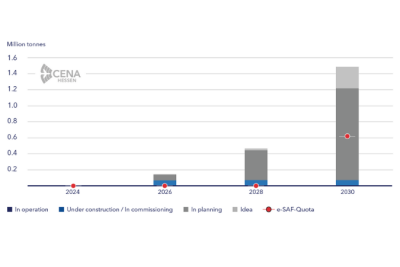
Production volumes compared to the e-SAF quota in the EU by project status
While fulfillment of the general SAF quota in 2025 and 2030 is realistic as things stand at present, the decisive factor for the e-SAF quota will be whether the planned large-scale projects can be implemented in a timely manner and the necessary investments mobilized.

CENA SAF-Outlook 2025-2030 (EN)
Volumes, Technologies and Markets for Sustainable Aviation Fuels
23.06.2025 download (PDF 2,87 MIB )
Demand for SAF remains low among airlines – with one exception: B2B
he largest consumers of SAF in Europe include Air France-KLM, the DHL Group, and IAG. In 2023, they each refueled between 50,000 and 90,000 tonnes of SAF. SAF accounted for 3.27% of total fuel consumption at DHL Group, 1.12% at Air France-KLM, and 0.65% at IAG.
While demand in the private customer business was and remains low, the B2B segment, especially air freight, shows a greater willingness to use SAF. This is because business customers can reduce their own Scope 3 emissions by using SAF. These are indirect CO₂ emissions that are not generated within the company itself, but along the entire supply chain – for example, through business travel, purchased products, or the use of the company's own services.
SAF producers need long-term purchase agreements
Less than 0.5 million tonnes of SAF have been secured through purchase agreements in the EU for 2030 – significantly too little to fulfill the SAF quota of 3.1 million tonnes prescribed for 2030. The majority of the agreed SAF purchase volumes relate to bio-SAF, while binding contracts for e-SAF are virtually non-existent to date. This is also due to the high production costs: according to EASA, producing one tonne of e-SAF costs around €7,695 – almost ten times the price of fossil Kerosene.
With purchase agreements, an airline commits to purchasing a certain amount of SAF from a manufacturer over several years. Unlike conventional kerosene, where contracts often only run for one to three years, SAF purchase agreements are usually designed to last five to ten years or longer. This increases planning security for the producer.
However, many of these purchase agreements are non-binding and contain economic clauses that ensure that the buyer only has to fulfill the obligation if it is economically viable or reasonable. Due to the high costs of SAF, these agreements can quickly become ineffective. While they send a positive signal to the SAF market, they do not provide a reliable financial basis for investments in new production facilities.