
Sustainable aviation fuels (SAFs) are considered essential for decarbonising the aviation industry. They must meet strict regulatory requirements for use in aircraft. These include technical suitability in accordance with ASTM standards, and chemical safety and environmental compatibility in accordance with the European REACH regulation. Approval of SAF is a complex process, as various standards and regulations must be met.

The path to approval for sustainable aviation fuels
Overview of regulatory requirements under REACH and ASTM
ASTM certification and technical approval from SAF
Kerosene, and therefore sustainable aviation fuel (SAF), must be officially approved for commercial use in aviation. The requirements for kerosene are significantly stricter than those for petrol or diesel for road transport, as aviation fuels must be highly reliable and safe. Technical approval is granted by the standardisation organisation ASTM International. If an aviation fuel, including SAF, is approved by ASTM, it is recognised internationally and can be used worldwide in accordance with the specified requirements. Several types of sustainable aviation fuel are already approved and regulated in accordance with the ASTM D7566 and ASTM D1655 standards.
Approval for use as a sustainable aviation fuel in accordance with ASTM D7566
Sustainable aviation fuel that has been approved in accordance with ASTM D7566 must meet the same requirements as conventional Jet A or Jet A-1 when blended with fossil kerosene. This ensures technical compatibility with existing infrastructure, including engines, flight systems, refuelling facilities, and logistics systems.
Various production methods for SAF are compatible with ASTM D7566. Each new production method must undergo an independent validation process to test its technical suitability. SAF undergoes several test phases to examine its chemical, physical and fit-for-purpose properties. In addition, tests are carried out on test benches, engines and auxiliary power units. This standardised process ensures the safety and performance of SAF and enables comparison with fossil kerosene, as well as assessment of its 'drop-in' capability.
The maximum Blending ratio for most types of SAF is 50%, since SAF typically contains fewer Aromatics than fossil kerosene. Aromatics cause the seals in aircraft engines to swell, thus maintaining their tightness. Table 1 summarises the approved types of SAF and their maximum blending ratios.
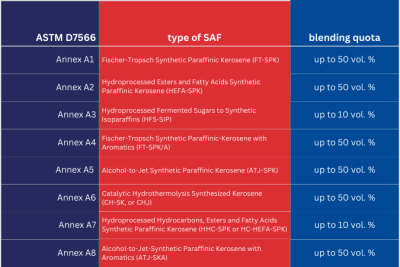
Approved synthetic SAFs according to ASTM D7566 and their permitted Blending ratios, Source: Jasiński, R., Kurzawska, P., & Przysowa, R. (2021)
Approval of sustainable hydrocarbons as feedstock for co-processing according to ASTM D1655
In co-processing, sustainable raw materials are processed together with fossil crude oil in existing refineries. This allows sustainable components to be blended in without the need for new facilities. The permitted Blending ratio of sustainable raw materials in co-processing is 5 percent of the feedstock volume. The end product is indistinguishable from fossil kerosene due to the joint processing and meets all the requirements of ASTM D1655.
A key advantage of the process is that, as the product meets Jet A and Jet A-1 specifications, it can be integrated directly into the existing infrastructure without any additional blending process. Refineries can therefore use sustainable components without separate certification.
However, the ‘indistinguishability’ of the kerosene also poses a challenge: since it cannot be chemically proven that this is actually SAF, special sustainability certificates are required. CENA Hessen is conducting research in the P2Fuels project on, among other things, what such a sustainability certificate could look like.
REACH – Impact of EU chemicals regulation on sustainable aviation fuels
Like all chemicals, SAFs must be registered in accordance with the European REACH chemicals regulation if they are to be placed on the EU market. The REACH Regulation aims to protect human health and the environment. According to the principle of 'no data, no market', the introduction and purchase of non-approved SAFs in the EU is prohibited.
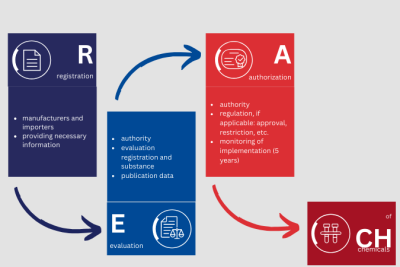
Simplified diagram of the REACH Registration process
Complex and expensive registration requirements even for pilot plants are hampering market ramp-up
In order to market SAF in the EU, it must be registered under REACH. The manufacturer or importer of SAF must provide data on its identity, properties, toxicology, and environmental risks, for which extensive studies are usually required.
The information requirements for REACH registration depend on the production volume. Since aircraft consume large amounts of fuel, SAF production requires correspondingly large quantities. Consequently, many producers exceed the volume threshold requiring registration at an early stage. This makes REACH registration very complex, even for small producers or importers, and incurs high costs due to the numerous studies required.
Cheaper co-registrations for SAF hardly possible
If a SAF with the same chemical composition has already been registered by another manufacturer or importer, it does not need to be registered again. These registrations are then combined as co-registrations. This can result in significant savings in terms of cost, time and effort.
This procedure has been possible without any problems for fossil Kerosene. However, the situation is different for sustainable aviation fuels: the most widely used registration is currently linked to the production of fuels derived from crude oil. As SAF is not derived from crude oil, however, it is not chemically identical under the REACH Regulation, so co-registration is not possible.
While there are other registrations that SAF manufacturers can join, it is unlikely that they will find a suitable one due to the small number of SAF registrations. It is also disproportionately expensive.
Regulatory framework for SAF: REACH registration and ASTM certification are essential for SAF
For manufacturers, compliance with ASTM specifications is crucial, as only with ASTM approval will aviation fuels be recognised and used by airlines, aircraft manufacturers, and aviation authorities. ASTM approval is also necessary to enable the international use of sustainable aviation fuel (SAF). In the European market, however, registering aviation fuel in accordance with the REACH Regulation is equally important. As an EU regulation, REACH applies in all member states. This means that SAF manufacturers must meet the technical requirements of ASTM and the regulatory requirements of REACH in order to bring their products to market in compliance with EU and international law.
More information



ASTM International. (2024): https://www.astm.org/d1655
ASTM International. (2024): https://www.astm.org/d7566
ASTM International (2023: https://store.astm.org/d4054-22.html
ECHA. (2021): https://echa.europa.eu/documents/10162/2324906/registration_en.pdf
ECHA. (2023): https://echa.europa.eu/documents/10162/2324906/guidance_on_data_sharing_en.pdf
Europäisches Parlament & Rat der Europäischen Union. (2006): https://eur-lex.europa.eu/legal-content/DE/TXT/?uri=CELEX%3A32006R1907
Gan et al. (203): https://doi.org/10.3390/su152416905
Haufe Online Redaktion (2012): https://www.haufe.de/arbeitsschutz/recht-politik/analyse-der-kostenbelastung-durch-reach_92_155204.html
Jasiński, R., Kurzawska, P., & Przysowa, R. (2021): https://doi.org/10.3390/en14123368