
Sustainable aviation fuels (SAFs) can be used to replace fossil kerosene. This article presents the most important types of SAF and their production methodes, ranging from biogenic pathways to synthetic fuel technologies. The focus is on the feedstock, the production process and and their inclusion in ASTM D7566 as certified fuel types.
Types of SAF and their production routes
Key technologies for sustainable aviation fuel production
Sustainable aviation fuels - definition and significance for aviation
SAFs are liquid aviation fuels developed from sustainable raw materials. Unlike conventional kerosene, they are not derived from fossil crude oil, but from biomass, waste, or atmospheric carbon dioxide (CO2) and hydrogen. Despite the different origin of the carbon, SAFs are so-called “drop-in” fuels. This means they are compatible with current aircraft and refuelling infrastructure and can be used directly following approval. The ASTM defines globally applicable criteria for the properties of alternative aviation fuels. Once approved by the ASTM, SAFs can be used in commercial aviation.
SAFs are categorised according to their production pathway, as their chemical properties differ. Manufacturing processes are divided into biogenic and synthetic categories according to feedstock used. Depending on the raw materials and the production route, there are also differences in their environmental compatibility. SAFs are seen as a short-term solution on the way to achieving more climate-friendly aviation. They are also more environmentally friendly, containing virtually no sulphur – a cause of particulate matter and acid rain - and having a significantly lower proportion of Aromatics than conventional kerosene. Aromatics burn incompletely, producing particulate matter that causes non-CO2 effects.
Biogenic SAFs: kerosene from fries fat, algae and other biomass
Biogenic SAFs are produced from renewable raw materials such as vegetable oils, sugars, starches or wood residues (lignocellulosic biomass). As they originate from a closed carbon cycle, they play a central role in both national and international funding strategies for the sustainable design of air traffic. This means that the carbon released into the atmosphere during combustion was originally captured by the plants used to produce the SAFs. However, the production processes, availability of raw materials and the chemical composition of biogenic SAFs can differ.
Hydroprocessed Esters and Fatty Acids Synthetic Paraffinic Kerosene (HEFA-SPK)
The HEFA process is currently the most commercially significant method of producing SAF. HEFA stands for „Hydroprocessed Esters and Fatty Acids“. The esters and fatty acids are first modified by adding hydrogen and removing oxygen (catalytic hydrogenation), then chemically converted (isomerised) and separated based on their chain length to obtain Kerosene of the appropriate size (fractionation). This results in HEFA-SPK, a fuel with physical properties similar to those of fossil kerosene.
The esters and fatty acids used in the HEFA process originate from biogenic sources such as vegetable oils (e.g. rapeseed, soybean or palm oils), used cooking oils (UCOs) and animal fats. HEFA-SPK contains no Aromatics, making it more environmentally friendly. However, aromatics are technically necessary for certain engine components. Therefore, HEFA-SPK may only be blended with fossil kerosene at a maximum ratio of 50%.
One type of HEFA-SPK is HC-HEFA-SPK, which is produced from algae. This uses the species of algae Botryococcus braunii, which has a particularly high content of unsaturated hydrocarbons. HC-HEFA-SPK is currently approved for a maximum content of 10 %.
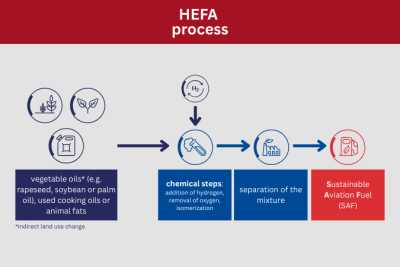
Schematic representation of the HEFA process
Alcohol-to-Jet Synthetic Paraffinic Kerosene (AtJ-SPK)
In the alcohol-to-jet (AtJ) process, aviation fuels are produced from alcohols such as ethanol or isobutanol. The alcohol used must first be extracted. There are two methods of doing this: production through the fermentation of biogenic raw materials or cellulose-containing residual biomass. This biological conversion relies on microorganisms such as yeast or bacteria.
Alternatively, the biomass can also be converted thermochemically (e.g. through gasification followed by further catalytic steps).
The next step is to chemically modify (dehydrate) the alcohols so that they can be linked together to form longer-chain molecules (oligomerisation).These are then treated with hydrogen (hydrogenation). Finally, the produced hydrocarbons are separated (fractionated) according to their chain length.
ASTM approval D7566 currently covers AtJ-SPK (Annex 5) and AtJ-SKA (Annex 8), which are AtJ fuels that contain Aromatics.
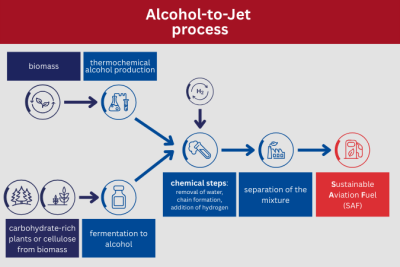
Schematic of the AtJ process
Synthetic SAFs: kerosene from hydrogen, CO2 and electricity
Synthetic SAFs are produced from CO₂, green hydrogen and renewable energy (power-to-liquid, PtL). The carbon dioxide can be sourced from either biogenic or industrial sources. However, in order to be recognised as a sustainable fuel under the EU RED II Directive‘s sustainability criteria, the CO₂ must not be of biogenic origin.
These raw materials are then processed into synthetic kerosene, also known as E-kerosene or electricity-based fuels - via the Fischer-Tropsch or methanol route. Synthetic SAF is highly pure and free of sulphur and other impurities. This makes it burn particularly clean. It is also considered to be particularly scalable as it does not require any biogenic (agricultural) raw materials , meaning it does not compete with food production.
Fischer-Tropsch Synthetic Paraffinic Kerosene (FT-SPK)
The Fischer-Tropsch process is a well-known method of synthesising hydrocarbons, but until now it has only been used with fossil resources. The process is still being developed for the production of SAF.
The PtL approach first requires a synthesis gas. This can be obtained by a reverse water gas shift (RWGS) reaction from carbon dioxide and hydrogen, or by gasifying solid or liquid biogenic materials such as wood, sewage sludge or municipal waste. However, in the latter case, the resulting fuel would not be RFNBO-compliant.
In the subsequent Fischer-Tropsch synthesis process, the gas is processed at high temperature and pressure to produce liquid hydrocarbons, which are refined in a final step at a refinery. The hydrocarbons produced FT-SPK are highly pure, containing hardly any impurities such as sulphur, or nitrogen. According to ASTM D7566 (Annex A1), SAF from FT-SPK may be blended with up to 50% fossil kerosene. A variant of FT-kerosene with Aromatics is FT-SPK/A .
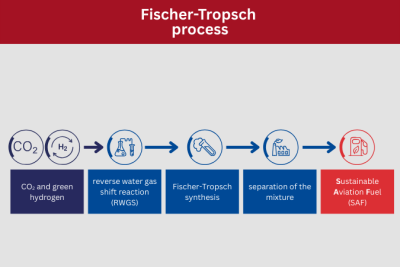
Schematic of the PtL process
Methanol-to-Jet (MtJ)
Another approach to producing SAF is the methanol-to-jet (MtJ) process. Although it has not yet received approval from the American Society for Testing and Materials (ASTM), the process is being tested in pilot plants around the world. Methanol is used as the raw material. To produce sustainable SAFs, green methanol is used in particular, which is produced from CO₂ and green hydrogen. The carbon dioxide used for this can come from direct air capture, biogas or industrial sources.
Conversion to jet fuel takes place in several steps:
1. Dehydration: methanol is chemically modified to produce dimethyl ether (DME).
2. Olefination: olefins are formed from DME. These are chemical substances that contain carbon-carbon double bonds.
3. Oligomerization: The olefins are linked together to form longer hydrocarbon chains.
4. Hydrogenation and fractionation: the chains are treated with hydrogen and separated according to their length.
A major advantage of the MtJ pathway is the flexibility of methanol production and the potentially lower gas quality requirements compared to the FT process. This makes the process more robust. In addition, methanol is already widely available in industrial quantities.
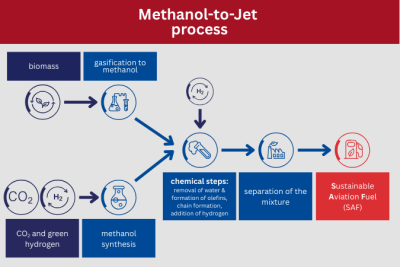
Schematic of the MtJ process
The most important SAF production paths at a glance
SAF production route |
Feedstock |
Brief description of the manufacturing process |
Approval according to ASTM D7566 |
HEFA-SPK |
Vegetable oils, used cooking oils, animal fats |
Vegetable oils, used cooking oils, animal fats |
Yes, up to 50% Blending share (Annex A2) |
HC-HEFA-SPK |
Algae species Botryococcus braunii |
Identical to HEFA with hydrocarbons, esters and fatty acids |
Yes, up to 10% blending share (Annex A7) |
AtJ-SPK |
Alcohol from cellulose, sugar beet or plants containing starch |
Biomass containing sugar and starch is converted/fermented into alcohol, then dehydrated, processed into kerosene and, if necessary, mixed with Aromatics |
Yes, up to 50% blending share (Annex A5) |
AtJ-SKA |
Alcohol from cellulose, sugar beet or plants containing starch |
Preparation of AtJ-SPK and subsequent addition of aromatics |
Yes, up to 50% blending share (Annex A8) |
FT-SPK |
CO2 from biomass, industrial point sources or DAC |
Reverse water gas shift to produce synthesis gas, Fischer-Tropsch synthesis and subsequent hydrogenation and fractionation |
Yes, up to 50% blending share (Annex A1) |
FT-SPK/A |
CO2 from biomass, industrial point sources or DAC |
Production of FT-SPK and subsequent addition of aromatics |
Yes, up to 50% blending share (Annex A4) |
MtJ |
Methanol from biomass or CO2 |
Dehydration to dimethyl ether, olefination and oligomerization, with subsequent hydrogenation and fractionation |
No |
More information

SAF regulation in Germany
Sustainable aviation fuels in Germany: an overview of the most important laws and regulations
Elwalily et al. (2025): https://doi.org/10.1039/D5SE00231A
Geleynse et al. (2018): https://doi.org/10.1002/cssc.201801690
Rosales Calderon et al. (2024): https://www.nrel.gov/docs/fy24osti/87803.pdf
Tao et al. (2017): https://doi.org/10.1186/s13068-017-0945-3