
The framework conditions for sustainable aviation fuels in Germany are determined by European regulation and additional national requirements. Specific German requirements include the target of greenhouse gas neutrality by 2045, the consistent cascading use of biomass, the higher Power-to-Liquid (PtL) quota and the aviation tax.

Use of sustainable aviation fuels in Germany
The most important laws and regulations at a glance
Federal Climate Action Act: Net greenhouse gas neutrality by 2045
The Federal Climate Action Act (German: Bundes-Klimaschutzgesetz; KSG) forms the basis of national climate policy in Germany and aims to achieve net greenhouse gas neutrality by 2045.
This requires efforts to reduce greenhouse gas emissions in all sectors, including aviation. Since the amendment of the Federal Climate Action Act in 2024, there are no longer any sectoral targets. The transport sector is therefore no longer considered separately. However, it should be noted that there are still targets for the use of renewable energy and the reduction of Greenhouse gases in the transport sector at the European level with Renewable Energy Directive (RED). The sector where greenhouse gases are emitted therefore remains relevant.
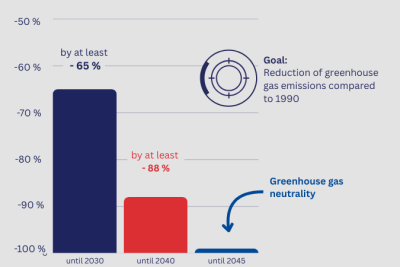
Greenhouse gas reduction pathway
Transfer of EU regulation for synthetic aviation fuels
The Federal Immission Control Act (German: Bundesimmissionsschutzgesetz; BImschG) and the associated Federal Immission Control Ordinances (German: Bundesimmissionsschutzverordnungen, BImSchV) transpose some of the requirements of the RED II into German law.
The BImSchG describes a quota for PtL from 2026. This quota specifies a higher proportion of PtL than the corresponding requirements at European level. However, the coalition agreement presented on 9 April 2025 provides for the German quota to be abolished in 2025, i.e. before it comes into force.
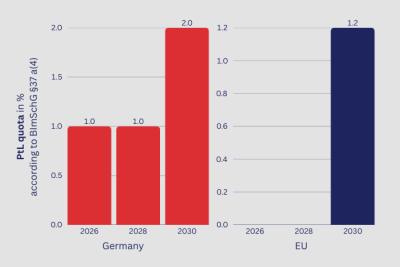
PtL-Quota according to BImschG §37 a(4)
Future vision for PtL kerosene in Germany: PtL roadmap for sustainable aviation
The roadmap defines the goal of making at least 200,000 tonnes of PtL Kerosene available for German aviation by 2030. It also discusses how the production of PtL kerosene in Germany can be expanded.
Some of the requirements formulated in the 2021 Roadmap, such as the definition of sustainability criteria for PtL kerosene or the setting of quotas, have now been implemented by European legislation.
Hydrogen: Key to synthetic fuels
The National Hydrogen Strategy identifies aviation, along with shipping, as an important future consumer of Synthetic fuels that require hydrogen for their production. Depending on technological developments, the direct use of hydrogen in aviation is also conceivable. In addition, the development of a refuelling infrastructure for liquid hydrogen and hydrogen derivatives will be examined.
In June 2020, the German government presented its first National Hydrogen Strategy (NWS), which sets out the goals of its hydrogen policy. The update published in 2023 aims to accelerate the expansion of hydrogen production. The national Electrolysis capacity is to be increased from 5 GW to at least 10 GW by 2030. However, it is expected that 50 to 70% of the estimated national hydrogen demand of 95 TWh to 130 TWh in 2030 will have to be met by imports.
Government subsidies will only be provided for green hydrogen. However, as there will initially be insufficient quantities of this hydrogen available, the use of low-carbon hydrogen (produced using nuclear power) is planned during the transition period.
Sustainable use of biomass
Biomass may only be used for fuel production in Germany if all other possible uses have been exhausted. In view of the increasing demand for biomass and the limited availability of sustainable biomass, the key points of the National Biomass Strategy (German: Nationalen Biomassestrategie, NABIS) require consistent cascading and multiple use. This means that priority is given to the material use of biomass to achieve the longest possible carbon sequestration. Only when material use is no longer possible will energy use be considered.
Biofuels for aviation are to be produced mainly from biomass such as waste or residues. A detailed list of permitted biomass feedstocks can be found here (link to EU article).
If biomass other than waste or residues is to be used to produce biofuels, certain sustainability criteria and requirements for certification and minimum greenhouse gas savings must be met in accordance with the Biofuel Sustainability Regulation (German: Biokraftstoff-Nachhaltigkeitsverordnung; Biokraft-NachV). This regulation transposes the RED, in particular §29 and §30, into German law. A greenhouse gas reduction of 50 to 65% is required for biofuels, depending on when the production plant was commissioned. The sustainability requirements include, for example, that the biomass must not come from areas of high biodiversity.
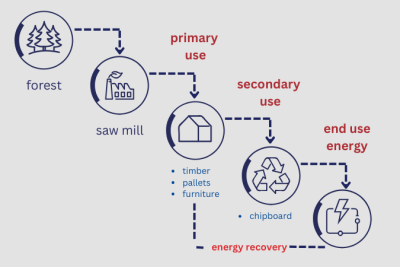
Cascade utilization of wood
The role of the aviation tax for climate-neutral aviation
Since 2011, an aviation tax (German: Luftverkehrsteuer) has been levied on commercial passenger flights from German airports. This tax was introduced to compensate for the tax advantages of air travel compared to other modes of transport. One of the main reasons for this is the tax exemption on Kerosene. The tax is also intended to encourage more environmentally friendly behaviour.
The amount of tax varies according to the distance of the flight and is divided into three distance classes. Class 1 covers short-haul flights within Europe and to some North African countries and Russia. Class 2 covers medium-haul flights to Central African and Arab countries and the Middle East. Finally, Class 3 covers long-haul flights to all other destinations. An overview of the tax per passenger since 1 May 2024 is shown in Table 2. However, the coalition agreement foresees a reversal of the increase in aviation tax from April 2025.
15,53 €
Tax rate for distance class 1
39,34 €
Tax rate for distance class 2
70,83 €
Tax rate for distance class 3
The amount of the tax has changed several times since its introduction in 2011, with a tendency to increase. The Aviation Tax Act (German: Luftverkehrsteuergesetz) provides for a possible reduction of the tax if the tax revenue exceeds EUR 2.33 billion in the previous year (§ 11).
The revenue from the aviation tax flows into the federal budget. The 2021 coalition agreement between the SPD, the Grünen and the FDP provided for this revenue to be used to promote CO2-neutral, synthetic aviation fuels as well as for research, development and modernization of the aircraft fleet. However, due to budget cuts, the revenue was not earmarked.
In December 2024, the German Federal Parliament debated for the first time a CDU/CSU motion entitled "Promotion of climate-neutral aviation". Among other things, the motion calls for the revenue from aviation tax to be specifically invested in aviation research and development projects, in particular in the production and use of sustainable aviation fuels.
More information




BMFTR (2023): https://www.bmftr.bund.de/SharedDocs/Downloads/DE/20/230726-fortschreibung-nws.pdf?__blob=publicationFile&v=4
Federal Government of Germany (2024): https://www.bundesregierung.de/breg-de/aktuelles/klimaschutzgesetz-2197410
Federal Office of Justice (n.D.): https://www.gesetze-im-internet.de/bimschv_37_2024/index.html#BJNR0830A0024BJNE001200000
Federal Office of Justice (n.D.): https://www.gesetze-im-internet.de/biokraft-nachv_2021/
Federal Office of Justice (n.D.):
/index.html#BJNR007210974BJNE011709130">https://www.gesetze-im-internet.de/bimschg/index.html#BJNR007210974BJNE011709130
Federal Office of Justice (n.D.): https://www.gesetze-im-internet.de/ksg/index.html#BJNR251310019BJNE001802130
Federal Office of Justice (n.D.): https://www.gesetze-im-internet.de/luftvstg/index.html
Federal Office of Justice (2024): https://www.recht.bund.de/bgbl/1/2024/235/VO
German Bundestag (2024): https://dserver.bundestag.de/btd/20/140/2014016.pdf
Federal Government of Germany (2021): -roadmap.pdf?__blob=publicationFile">https://www.bmv.de/SharedDocs/DE/Anlage/LF/PtL-Roadmap.pdf?__blob=publicationFile
Wiwo (2025): https://www.wiwo.de/downloads/30290756/8/koalitionsvertrag-2025.pdf